Pesticide and Fertilizer Use in Tobacco Cultivation: Impacts on Water Sources and Biodiversity
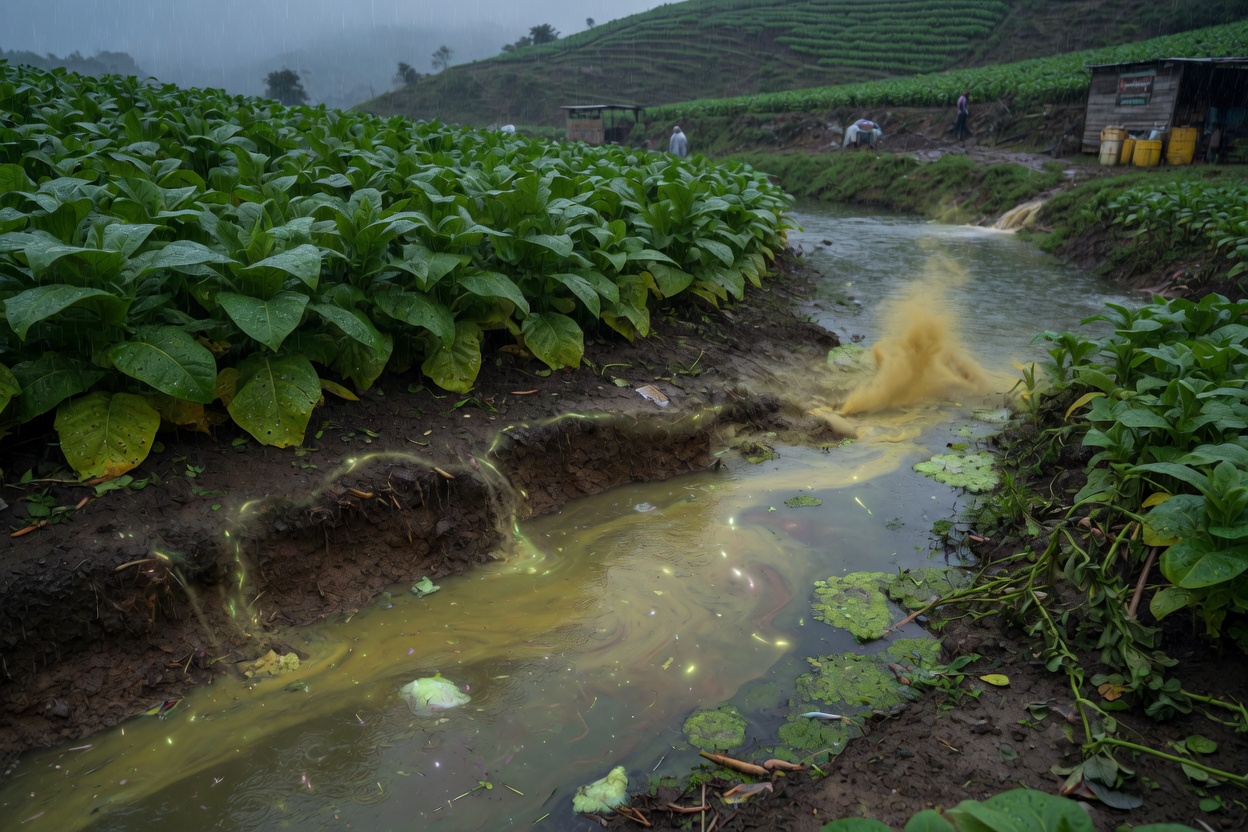
In mid-June 2022, in a tobacco-growing township in Qujing, Yunnan, after two consecutive days of convective rain, I walked along a dirt ditch extending from a tobacco ridge furrow. The water at the bottom of the ditch was yellow, carrying the sweet-sticky smell of compound fertilizer and a faint medicinal odor. The ditch emptied directly into a village stream, which then merged into a larger tributary. Old Zhou, a farmer squatting on the ridge lighting a cigarette, said casually: "The rain came too fast. Half of the fertilizer we just top-dressed on the ridge was probably washed away. Same with the pesticides — the instructions say don't apply before rain, but when the pests get bad, nobody waits."
That one sentence made things clearer than any PowerPoint — the pesticides and fertilizers used in tobacco fields don't just affect leaf quality; a significant portion leaves the fields via slopes and drainage systems. Once they leave, they enter ponds, tributaries, and shallow groundwater, altering the living conditions of aquatic organisms and natural field predators.
This article focuses solely on this chain: input structure of agrochemicals → pathways into water sources → pressure on biodiversity. It does not portray tobacco as the sole environmental culprit — any intensive leafy vegetable, orchard, or facility vegetable farming has non-point source issues. However, as a high-input, appearance-sensitive, contract-purchased crop, tobacco has pushed "chemical assurance" to a very high routine intensity across many production areas. Public research and international tobacco control-environment documents repeatedly point to the same set of risks: chemical contamination of water and soil, eutrophication, habitat and biodiversity loss.
I. Setting the Boundaries First
How do pesticides and fertilizers from tobacco cultivation enter water sources?
What pressures do they exert on biodiversity?
Where are the directions for reduction and management?
- **Water source and biodiversity issues ≠ a substitute narrative for smoking health issues.** Nitrogen, phosphorus, and pesticides in the fields concern watershed and farmer health exposure; the core health risks of smoking still stem from combustion and inhalation. Both lines can coexist without canceling each other out.
- **Trends are at the production area and watershed scale, not a verdict on every individual field.** Slope, soil texture, whether pesticides were applied before rain, whether drainage ditches connect directly to rivers, and whether upstream crops or livestock exist — these factors can make two neighboring villages very different.
- **"Using pesticides according to instructions" can still accumulate at the watershed scale.** A single dose may be compliant, but the total load on the catchment area may not be acceptable; the trouble with non-point source pollution is precisely that it is dispersed, hard to trace, and subject to pulsed emissions during rainy seasons.
- **Technical pathways exist; the incentive structure is another matter.** Reduced fertilization, organic alternatives, integrated pest management (IPM), buffer zones, and GAP — all have demonstrated results in trials and demonstrations. Whether they can become the norm across an entire small watershed under procurement price and grading pressure is the real constraint.
II. Why Tobacco Fields Tend to Have High "Agrochemical Density"
1. Leaf use + appearance-based pricing creates "zero tolerance" for pest spots
Flue-cured and air-cured tobacco is sold by the leaf. Insect holes, disease spots, and malformed leaves directly affect grading and average price. Farmers and grassroots technicians face not "is there enough to eat" but "will this batch pass grading at purchase." As a result, preventive spraying, hit-pests-when-seen, and post-rain reapplication become very dense in the actual calendar — even if the technical plan says "threshold-based control."
2. Continuous cropping, dense planting, and phased nitrogen application create dual pressures of pests and runoff
| Production Feature | Field Implication | Driver for Agrochemicals and Environment |
|---|---|---|
| **Continuous cropping preference** | Suitable tobacco areas are limited; orders are stable | Soil-borne diseases and aphid-borne viruses rise → reliance on fungicides/insecticides |
| **High potassium, phased nitrogen** | Early growth promotion, late nitrogen control for maturity | Top-dressing window overlaps with rainy season → high nitrogen runoff/leaching risk |
| **Chlorine-averse system** | Heavy use of potassium sulfate, less potassium chloride | High cost of specialized fertilizers; farmers sometimes "add urea to maintain growth" to compensate visually |
| **Ridge cultivation and drainage** | Prevents waterlogging, promotes roots | Ridge furrows become **rapid transport belts** during heavy rain, sending soil, fertilizer, and pesticides into ditches |
| **High labor cost** | Spraying relies on manual labor or simple motorized sprayers | Difficult to target precisely; drift and overspray are common |
3. What a typical agrochemical calendar looks like (and where the problems lie)
Using the common rhythm of southwestern mountain flue-cured tobacco as an example (schemes vary by region, but the logic is similar):
- **Land preparation—before ridging**: Base application of tobacco-specific compound fertilizer (common type: controlled nitrogen, increased potassium) + some organic fertilizer; some fields mix in granular insecticides for underground pests.
- **7–15 days after transplanting**: Check and replant seedlings; first insecticide application when aphid and cutworm pressure rises; watch for root and stem diseases when soil moisture is high.
- **Rosette—vigorous growth**: Top-dressing (mainly nitrogen and potassium); also a critical window for virus diseases, brown spot, bacterial wilt control — spraying frequency tends to increase.
- **Topping—before harvest**: Nitrogen control; still possible to apply supplemental pesticides for caterpillars, aphids, or leaf spot; strict production areas enforce **pre-harvest intervals** with variable rigor.
- **After harvest**: Tobacco stalks removed; the sediment and residual nutrients from the previous season washed into ditches — hardly anyone accounts for this as "pollution."
Specific issues I repeatedly encountered in interviews between 2019–2022:
- **Spraying 6 hours before rain**: The weather forecast said "possible rain," but pest pressure was high — farmers chose to gamble; the pesticide solution couldn't form an effective deposit on the leaf surface, and part of it entered the ditches with runoff.
- **Washing sprayers in the river**: For convenience, rinse water was dumped directly into drainage ditches — a point-source "micro-discharge" more glaring than drift.
- **"One-shot" base fertilizer + additional urea during vigorous growth**: The technician prescribed a nitrogen-controlled plan, but field execution often became "add more if the color isn't green enough"; excess nitrate nitrogen on sandy loam and sloping fields could be redistributed to streams after one heavy rain.
- **Blame games after fish died in neighboring ponds**: No one could tell which tobacco field, which pesticide application, or whether upstream vegetable fields or domestic sewage were responsible — the "anonymity" of non-point sources lets everyone feel their own contribution is negligible.
Private Cost
Insect spot losses borne by farmer
Public Cost
Nitrogen and pesticides borne by downstream water, fisheries, public finance
III. Fertilizers: Two Main Routes from Ridge Furrow to Water Sources
1. Background: China's farmland fertilizer intensity has long been relatively high
The Ministry of Agriculture and Rural Affairs, while promoting the "zero growth in fertilizer use" action, has publicly stated that China's average fertilizer use per mu is about 21.9 kg, significantly higher than the world average at the time (about 8 kg per mu level) and also higher than the average of many intensive agricultural areas in the US and Europe. Tobacco is just one of many crops, but tobacco areas are often among the highest input intensity fields at the county level — superimposing the "nationally high" background onto the "higher management density of tobacco fields" means the non-point source contribution cannot be lightly dismissed with "it's only one season of tobacco."
2. Nitrate leaching: the invisible groundwater pathway
Ammonium nitrogen fertilizers and urea, after entering the soil, rapidly nitrify into nitrate (NO₃⁻) in well-aerated tobacco fields. Nitrate carries a negative charge, is not easily adsorbed by soil colloids, and moves with infiltrating water below the root zone into shallow groundwater.
The implications for water sources are straightforward:
- Rural decentralized wells drawing shallow water face elevated nitrate levels, linked to gastrointestinal and maternal-child health risks (a clear discussion framework exists in public health literature);
- Nitrate entering spring and headwater areas, when combined with urban wastewater and other farmland loads downstream, raises total nitrogen levels.
Tobacco's "late-stage nitrogen control" technical requirement is intended for quality; what actually enters water bodies is often the nitrogen from early over-application and mismatched timing with rainy seasons — not the theoretical dosage on paper.
3. Surface runoff and eutrophication: the visible yellow water pathway
Sloping farmland + ridge furrow drainage + rainy season form the classic combination for nitrogen and phosphorus entering surface waters:
| Process | Occurrence Conditions | Main Carried Substances | Water Body Consequences |
|---|---|---|---|
| **Raindrop splash erosion + sheet flow** | Bare surface after transplanting, heavy rain | Surface soil fine particles, adsorbed phosphorus | Tributary turbidity, reservoir bay sedimentation |
| **Ridge furrow convergence** | Ridged fields, well-drained | Dissolved nitrogen, some pesticide solution | Pulsed total nitrogen increase |
| **Drainage ditch directly to river** | Lack of buffer zones/sedimentation ponds | Sediment + nutrients + pesticide residues | Catchment total load hard to reduce |
| **Irrigation return flow** | Irrigated tobacco fields in flat areas | Nutrient return flow | Ditch eutrophication, algal attachment |
Phosphorus tends to be more "sticky" to soil particles and travels with sediment; nitrogen is more "mobile" with a higher proportion in dissolved form. Both, when entering lakes and reservoirs, become food for algae.
Regional context (not solely tobacco's burden): Taking Dianchi Lake as an example, public research using long time series from 1979–2023 shows that water quality has experienced degradation—improvement through treatment—still subject to non-point and internal source fluctuations; nitrogen and phosphorus concentrations once far exceeded Class V surface water standards, and rainy season inflow loads and nearshore highs remain challenging. Tobacco is only part of Yunnan's agriculture, but it reminds us: in plateau lake watersheds, any high-input farmland contributes to the same total account. In watersheds like Erhai, "organic fertilizer replacing chemical fertilizer, nitrogen and phosphorus reduction" trials alongside tobacco yield and quality experiments show that policy and research have long placed tobacco field nutrient loss within the lake protection agenda — not pretending tobacco fields have nothing to do with water.
4. Tobacco "extracts more nutrients" than average crops, fueling the next round of fertilization impulse
Public discussions and reviews often note that tobacco's consumption intensity of nitrogen, phosphorus, and potassium is higher than many comparable crops. After continuous cropping, soil fertility and nutrient uptake efficiency decline, making farmers more inclined to "add more fertilizer" to maintain growth. The previous article on soil covered depletion and acidification; here only one water-related point — the more acidic and structurally degraded the soil, the weaker its fertilizer retention, and the higher the proportion of applied fertilizer entering water bodies. The agrochemical issue and the soil issue are two sides of the same coin.
IV. Pesticides: Drift, Wash Water, and Rainy Season Pulses
1. Tobacco field pesticides are not "one pesticide" but a series of windows
| Type | Common Targets | Environmental Sensitivities |
|---|---|---|
| **Insecticides** | Aphids, tobacco budworms, cutworms, etc. | Bees and other pollinators, aquatic arthropods, fish |
| **Fungicides** | Black shank, brown spot, anthracnose, etc. | Soil microbiota; increased use following resistance buildup |
| **Herbicides** | Inter-row weeds | Algae and aquatic plants in runoff-receiving ditches; nearby non-target crops |
| **Plant growth regulators** | Sucker control, etc. | Use and residue management often overlooked yet entering the same drainage system |
At the international level, the World Health Organization's Framework Convention on Tobacco Control and related environmental discussions have long called for attention to water and soil pollution caused by pesticides in tobacco-growing areas, promoting monitoring and awareness. This is not a moral slogan but an acknowledgment that tobacco leaves, as a globally traded crop, carry a transboundary environmental footprint from field chemicals.
2. Four specific pathways into water sources
- **Foliar spray drift**: Spraying on windy days; droplets leave the field; plots near rivers are effectively aerial non-point sources.
- **Pre-rain application and post-rain wash-off**: Active ingredients not yet absorbed by leaves or adsorbed are carried away by runoff.
- **Equipment washing and discarded packaging**: Rinse water, bottles, and bags discarded by ditches — "high-concentration point sources" in management gaps.
- **Soil adsorption followed by desorption**: Certain active ingredients migrate with colloidal particles and enter rivers with sediment during heavy rain.
During a sampling break in southern Guizhou, I asked a local whether the ditch water could be used to water cattle. They laughed: "Cattle don't drink from this ditch; they drink from the mountain spring up there." People's own water source grading by preference often appears earlier than any testing report.
3. Risk logic for humans and aquatic organisms (popular science level)
- **Acute exposure for applicators**: During tobacco spraying season, compliance with protective clothing and masks is uneven; this is an occupational health issue, often written separately from environmental issues, though they share the same root.
- **Acute/subacute toxicity to aquatic organisms**: Organophosphates, some pyrethroids, and neonicotinoids have clear toxicity spectra in literature for fish, daphnia, and aquatic insects; specific registered products change, but **"a new pesticide name ≠ no pressure on aquatic life."**
- **Chronic and ecological chain effects**: Long-term low-concentration inputs can alter benthic community structure, subsequently affecting fish and birds that feed on aquatic insects — biodiversity loss often first appears as "species composition shifts" rather than headline news about a flagship species suddenly going extinct.
V. Biodiversity: From One Tobacco Ridge to a Body of Water
1. Field scale: natural enemies and pollinators pay first
Broad-spectrum insecticides do not distinguish between "pests" and "aphid parasitoids, ladybugs, lacewings." Neonicotinoids and other systemic pesticides have sparked major controversy in global pollinator research. If tobacco fields are near flowering crops or wild nectar plants during application, the toxicity enters the insects' food web.
Soil fauna are equally sensitive. In continuously cropped tobacco fields, farmers often report "fewer earthworms, soil compaction" — a combined result of organic matter and pH issues as well as the dual pressure of agrochemicals and fertilizers. The direct consequence of declining field biodiversity is greater reliance on pesticides the following season — a positive feedback loop.
2. Landscape scale: contiguous tobacco fields and habitat simplification
Contract farming favors contiguous fields for convenient technical guidance and procurement. The cost of contiguity:
- Ridge weeds, shrub strips, and small wetlands are cleared → natural enemy refuges reduced;
- Crop rotation diversity declines → seasonal food sources for insects and birds become discontinuous;
- In some African and Asian production areas, public environmental assessments link tobacco cultivation to **deforestation and firewood curing** — forest clearing directly destroys wildlife habitat and brings erosion and agrochemicals into waterways. China's main production areas face different constraints, but the "single-crop landscape" logic of biodiversity simplification holds universally.
3. Water body scale: eutrophication rewrites the underwater world
Nitrogen and phosphorus pulses → phytoplankton blooms → declining transparency, nocturnal dissolved oxygen fluctuations → sensitive fish and benthic organisms eliminated, tolerant species dominant. This is not tobacco-exclusive but the common outcome of all agriculture delivering nutrients to lakes and reservoirs. Tobacco's particularity: when heavy rain coincides with top-dressing and spraying windows, nutrients and some pesticide residues can leave the field in the same flood event — a combined punch to small ponds and slow-flowing ditches.
Case studies from Bangladesh, Pakistan, Malawi, and elsewhere (published papers and environmental assessments) repeatedly document declining water and soil quality and impaired biodiversity in tobacco-growing areas; South Asia and Africa have different institutional contexts from China, but the chemical dependence—runoff—habitat degradation chain is comparable — avoid the illusion that "it only happens in other countries."
4. A reference table: where the impacts fall
| Scale | Main Pressure Source | Visible Signals | Recovery Difficulty |
|---|---|---|---|
| **Field** | Broad-spectrum insecticides, frequent disturbance | Few natural enemies, pest rebound, few earthworms | Medium (change practices, visible in 2–3 seasons) |
| **Ditch—tributary** | Nitrogen, phosphorus + pesticide pulses | Algal growth, fewer fish, odor | Medium-high (requires whole ditch coordination) |
| **Lake—reservoir** | Total watershed load | Water quality class fluctuation, algal blooms | High (decade-scale engineering + non-point source control) |
| **Regional habitat** | Contiguous monoculture, deforestation (some areas) | Declining species richness | Very high |
VI. Reduction and Management: Not a Lack of Solutions, But Solutions Often Stay in Demonstration Fields
1. Approaches already proven useful
- **Soil testing and formulated fertilization + organic-inorganic combination**: Reduces "insurance over-application"; partial substitution of chemical fertilizers with organic alternatives has been evaluated alongside nitrogen and phosphorus loss and tobacco yield/quality in watersheds such as Erhai.
- **Integrated Pest Management (IPM)**: Sex pheromones, colored sticky traps, natural enemy release, disease-resistant varieties, proper planting density, and field sanitation — shifting chemical control from "calendar spraying" back to "threshold-based control."
- **Buffer zones and ecological ditches**: Maintaining vegetation strips and sedimentation sections between fields and waterways to reduce sediment and nutrient flow velocity — similar requirements appear in tobacco GAP materials: establish protection belts between farmland and vulnerable water bodies to mitigate agrochemical movement and also benefit wildlife habitat.
- **Discipline of stopping fertilizer and pesticide application before rain**: The simplest approach and often the most effective; what's needed is early warning information and procurement standards that don't excessively penalize "one skipped spray resulting in a few insect holes" — this flexibility is the hardest part.
2. My clear view
The main contradiction is not farmers' "ignorance" but the distribution of costs and risks.
- Insect spots on leaves — the loss is borne by the farmer and that season's average price;
- Nitrogen and pesticides in ditches — the loss is borne by downstream drinking water, fisheries, and public finances;
- The more procurement standards scrutinize appearance, the more economically rational preventive chemical inputs become.
So "training sessions + distributing one season of biological pesticides" alone will hardly bend the curve. What can truly change the structure: whether grading rules allow some ecological tolerance, whether procurement prices cover the risk of reduced chemical input, whether small watersheds include tobacco field non-point sources as verifiable indicators under the river/lake chief system, and whether continuous cropping is constrained by rotation subsidies or contract terms.
Technically, I hold limited optimism about "organic tobacco" and "pollution-free tobacco": they can reduce field chemical intensity and are worth promoting; but if the world continues to burn tobacco on a large scale, the environmental ledger of deforestation, energy use, and consumption-side pollution will not be automatically offset by improvements in cultivation and harvesting. For readers, understanding agrochemicals—water—biodiversity means seeing the land and rivers before a single cigarette — not obtaining a "green tobacco" get-out-of-jail-free card.
3. Three honest points to hold onto when writing or reading
- **Tobacco field drainage ditches are pipelines, not natural boundaries.**
- **A compliant per-acre dosage, when summed, can still overload a watershed.**
- **Biodiversity decline will, in turn, raise next season's pesticide bill.**
VII. Risk Inventory (Based on Existing Research and Production Area Observations)
| Risk Type | Mechanism Summary | Evidence/Context Type | Common Amplifying Conditions |
|---|---|---|---|
| **Groundwater nitrate** | Nitrification of urea/ammonium nitrogen followed by leaching | Classic agricultural non-point source pathway; high nitrogen windows in intensive tobacco areas | Sandy loam, flood irrigation, excessive base and top-dressing |
| **Surface water nitrogen and phosphorus** | Runoff and sediment transport | Lake eutrophication research; nitrogen reduction trials in tobacco areas | Rainy season top-dressing, sloping fields, no buffer zones |
| **Pesticide residues entering rivers** | Drift, wash-off, rinsing water | FCTC/environmental health literature on agrochemicals in tobacco areas | Pre-rain spraying, washing equipment by rivers |
| **Aquatic organism toxicity** | Insecticide effects on non-target species | General ecotoxicology + production area case studies | Direct discharge to fish ponds/slow-flow ditches |
| **Pollinator and natural enemy decline** | Broad-spectrum and systemic insecticides | Field ecology | Adjacent to flowering periods/nectar sources, calendar spraying |
| **Soil fauna and microbial simplification** | Agrochemicals + continuous cropping | Continuous cropping obstacle and tobacco soil research | Low organic matter, acidification |
| **Landscape habitat loss** | Contiguous fields and (in some areas) deforestation | International environmental assessments | Expansion planting, firewood curing |
VIII. Closing: Read This "Pesticide Residue Article" as a Watershed Map
If you only remember the slogan — "tobacco pesticides and fertilizers pollute the environment" — the information content is roughly zero. A more useful reading is to lay it out as a map:
- At the **field** level, you see grading, insect holes, timing of top-dressing;
- In the **ridge furrow**, you see yellow water and medicinal odor after rain;
- In the **tributary and well**, you see anonymous total nitrogen and occasional strange smells;
- In the **habitat**, you see fewer natural enemies, fewer fish in ditches, and more pesticide bottles next season.
My judgment standing by that dirt ditch in Qujing has not changed: The pesticide and fertilizer problem in tobacco cultivation is essentially a high-value leaf crop pushing private quality risk to its minimum while leaving public water and biodiversity risk off the books. Reduction, GAP, buffer zones, and organic alternatives should all be pursued — and some people are already doing so. But until procurement prices and zero-tolerance appearance logic are rewritten, the beautiful data from demonstration fields will not automatically become clean water in entire rivers.
Smoking is harmful to health. Understanding the upstream water and ecological costs is about telling the full story of the chain — not about finding a "at least I care about the environment" psychological shield for continuing to smoke.
Disclaimer: This article is an agricultural-environmental and popular science review, based on public research trends, policy statements, and common production area practices. It does not constitute any field's monitoring conclusion, cultivation prescription, environmental lawsuit, or regulatory determination basis. Specific pesticide and fertilizer use must comply with local registered product labels and agricultural/ecological-environmental regulatory requirements. Loss and ecological effects vary greatly by year, soil type, and meteorological conditions.
Data from Ministry of Agriculture and published research