How Offline Smoking-Cessation or Dental Services Can Raise Revenue per Square Meter and Profit Through Content
I once managed two stores: one in Binjiang, Hangzhou — 120 sqm, two consulting rooms plus a basic intraoral scanner, focused on smoking-cessation assessment and nasal-inhalation support plans, and also doing basic smoking-related oral check-ups; the other was a "Smoking-Related Oral Specialty" held two days a week inside a partner dental clinic in the western part of the city. From September 2023 to June 2024, we changed from "posting on WeChat Moments and waiting for customers" to "content drives bookings, and bookings fill the schedule". With the same floor area, average monthly actual revenue climbed from roughly 180,000 to 270,000–290,000 yuan. Not a miracle — we simply tightened every variable in the revenue-per-square-meter formula that could be moved.
Below, I write about the pitfalls I stepped into: which link of revenue per square meter content actually changes, how to acquire customers, how to bring people into the store and close deals, and how to use content to raise the average transaction value.
I. Don't memorize the definition — first calculate where your store is losing money
First figure out where your store loses money; then you'll know which link content should tighten.
Many people treat revenue per square meter as a performance-review word. I only remember one chain of multiplication:
Monthly revenue per sqm ≈ (number of visitors × conversion rate × average transaction × repurchase/attachment coefficient) ÷ floor area
The Binjiang store was 120 sqm, and rent, utilities, and labor were fixed costs that squeezed hard. Before September 2023, natural walk-ins were 6–8 people a day, the conversion rate about 35%, average transaction around 1,800 yuan, and almost no systematic repurchase. Content can mainly touch the first three items:
| Lever | What content can do | Our handle at the time |
|---|---|---|
| Visitors | Turn people who scroll past into schedulable bookings | Short videos + local-life platform + WeCom confirmation |
| Conversion rate | Build trust and problem awareness before the visit | Test previews, case comparisons, consultant persona |
| Average transaction | Pre-plant package and upgrade logic | Content explains "phased plans"; in-store upgrades based on test results |
| Repurchase/attachment | Keep appearing on the customer's phone after they leave | Check-in group, 7-day/30-day follow-up content |
My personal view is blunt: stores like smoking-cessation and dental care should not fantasize about being fed by natural street traffic. Decisions are heavy, customers fear being tricked, and a lot of explanation is needed — if you haven't done the homework before they walk in, the visit only becomes a long bargaining session, and empty chairs and consulting rooms cost more when idle than when busy.
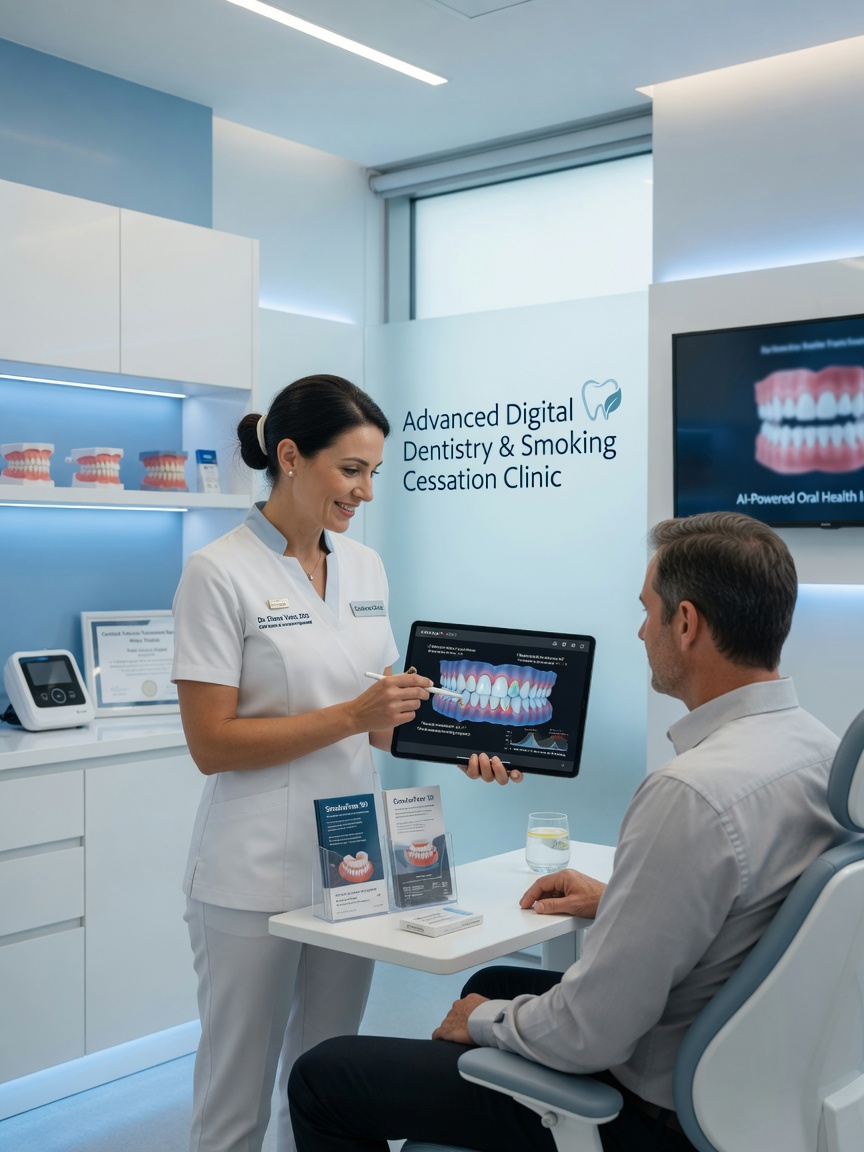
II. Why this type of project especially feeds on "content → visit"
Delivery must be offline, trust is expensive, empty slots cost money — why this type of store has to rely on content-driven booking.
At the end of 2023, I ran a two-week comparison in Binjiang: same pricing, group A only ran Meituan group-buy ads for teeth cleaning / smoking-cessation screening; group B posted 15–45 second "smoker's intraoral real shots + consultant explanation" clips on Douyin and guided viewers to book in-store tests. Group A had low lead cost, but a high share of people who left within 20 minutes of arriving, and sales relied on hard pushing; group B had higher booking confirmation rates, and visitors would proactively ask "how do I do that white-spot self-check you mentioned in the video", cutting the sales script in half.
The reason isn't complicated:
- Delivery must happen offline — intraoral scanning, exhaled carbon monoxide, periodontal probing, and in-person treatment planning can only be "planted" online.
- Trust costs more than retail goods — customers fear "membership pitches", exaggerated cessation claims, and overtreatment. If content keeps explaining mechanisms and boundaries over time (when to go to a hospital, that nasal-inhalation support is not magic), defensiveness drops a notch at the visit.
- Empty slots are expensive — no one in the consulting room from 10:00 to 12:00, crowded at 3 p.m., and peaks and valleys eat the revenue per square meter. One value of content is shaving the peaks and filling the valleys, using bookings to fill cold slots such as 10:30 and 14:00.
Across the industry, dental stores doing short videos / local promotion and building doctor IPs are essentially doing the same one thing: using content to turn "I want to know more" into "I've booked a specific time". Public cases also often show opening-day fission and private-domain mass messages about implants/cleaning that drive bookings; what I care more about is whether a small team can update weekly and reply to leads within 3 minutes, not copying the myth of 13-level fission.
III. Content acquisition: four plays we actually ran successfully
Four plays we actually ran: problem-visibility videos, a consultant IP, live Q&A, and cross-industry co-branding.
1. "Making the problem visible" short videos (main battlefield)
Topic angle: don't film "how professional we are"; film images customers can match themselves to — layered tar stains, animated comparisons of gum recession, a spoken account of taste changes on day 3 of quitting, and the relationship between bad breath and tongue coating (mind compliance and privacy: real people sign authorization for appearing on camera; pathology is only popular science, no diagnosis promises).
Rhythm: 4 videos a week, fixed posting 18:30–20:00 Tuesday to Friday; one recap or Q&A on weekends. The script template is fixed in four parts: pain point 3 seconds → mechanism 10 seconds → what the store can do 10 seconds → booking hook.
Traffic hook: pin a comment "reply 1 to get the Smoking-Related Oral Self-Check List", and auto-reply booking links in DMs; on the local-life platform, list "59 yuan smoking-related oral assessment + CO test", limited to 8 spots a day, with a mandatory time slot.
Where it backfired: in November 2023, we shot exaggerated before/after shots chasing a hit, and the comments called it "staged"; bookings surged that week but in-store complaints also rose. We then set the rule: the visuals can be dramatized, but the data must come from test sheets and individual differences must be stated aloud. A hit is fine, but credibility is not for sale.
2. Consultant/doctor personal IP (trust accelerator)
The Binjiang store had a consultant, Xiao Chen — not an influencer face, but steady in speech. We had him appear on camera to say "why I advise you not to buy a three-year card at once" — this kind of "anti-selling" content got better completion rates and DM quality.
Operation: the persona carries one main tag only (smoking-cessation behavior intervention or smoking-related periodontal science), appearing twice a week; he replies in the comments himself, no outsourced scripts. When customers walked in asking for "the one in the video", the conversion rate was clearly higher than random assignment.
My judgment: having everyone shoot videos is a disaster. Front desk, nurses, and consultants all filming fragments the style and ruins the account. Pick 1 main IP + 1 backup, and everyone else only supplies case material and on-camera authorization.
3. Live streaming / community Q&A (digesting hesitant leads)
A 40-minute Q&A every Thursday at 8 p.m., no hard selling. Prepare 10 high-frequency questions: nicotine and dry mouth, whether to pause brushing when gums bleed during withdrawal, nasal-inhalation support vs. gum, and what situations must be referred to a dental department.
Conversion move: the livestream only shows "next-day 10:00–11:30 open-slot booking code", deliberately not the full day. As a result, cold slots fill up and hot slots stay for high-ticket treatment-plan consultations.
Pitfall: once the livestream went too deep, like an academic presentation, and the online audience halved. We changed it to "one question answered in 90 seconds + one in-store action", and completion came back.
4. Cross-industry content co-branding (cheap precise traffic)
In March 2024, we made 4 collaborations with a fitness studio in the same mall, themed "people who still smoke while cutting fat — heart, lungs, and gums collapse together". We cross-promoted bookings, each offering 20 experience slots.
The cost was almost only time. 37 people visited, 14 deals closed; the average ticket was low but the referral rate was high — this group was active in communities and later became the seed of the check-in group.
For cross-industry, don't pick big-and-everything; pick adjacent categories sharing the same anxiety: fitness, sleep, skin management, and checkup centers all work. The content must be something both sides can talk about, not just advertising for the other side.
IV. In-store conversion: the timetable from walk-in to payment
From arrival to payment, nail lead response, double confirmation, a visible first assessment, and three plan tiers to the timetable.
Content brings leads, not money. We nailed the chain to the clock — this, I believe, is a more important profit engineering than "posting two more videos".
1. 3-minute lead response
WeCom/Douyin DM timeouts — in October 2023 we tracked: if the reply took more than 30 minutes, the booking confirmation rate dropped below 40%; replying within 3 minutes and offering two optional slots pushed confirmation to around 70%.
The script avoids marketing tone, straight:
I saw you're interested in smoking-related oral care / cessation assessment. Our Binjiang store still has this week: Wednesday 10:30, Thursday 14:00. Which suits you? The visit takes 25–30 minutes; we first do a CO test and basic intraoral look, then you decide whether you want a plan. No forced membership.
2. Double confirmation: the day before + the morning of
The no-show rate once hit 28%. After adding "5 p.m. confirmation the day before + route guidance at 9 a.m. the day of", no-shows dropped to about 12%. The confirmation message also includes: how to park, whether to bring medical records, whether you can eat breakfast — reducing visit anxiety.
3. Provide a "visible first assessment" within 15 minutes of arrival
When the customer sits down, don't sell first. Our process:
- Front desk builds the record in 2 minutes (years of smoking, cigarettes per day, oral complaints)
- Test 8–10 minutes (CO, intraoral scan or intraoral photos)
- The consultant points at images on screen for 5 minutes: where the tar stain is, what looks like a gum problem, roughly how many tiers the cessation plan splits into
With images and numbers, bargaining conversations drop by half. Without something visible, the customer only hears a price, and everything content planted goes to waste.
4. Offer only three tiers, don't throw nine packages at once
We paid to learn: one time we laid out six packages, the customer was overwhelmed, said "let me think at home", and never came back. We later fixed three tiers:
- Trial tier: test + behavior advice + basic care advice (digests group-buy customers)
- Intervention tier: 4–8 weeks of follow-up + nasal-inhalation support plan (main profit)
- Combined tier: cessation intervention + periodontal cleaning/tar-stain management referral collaboration (high ticket)
Content had already repeated this three-tier logic, so the visit is just "matching the seat", not education from zero.
5. No deal that day: 48-hour content follow-up, no phone bombardment
Send the test screenshot (blurred) + one practical tip like "if you have a lot of social drinking this week, you can start with Action A". If the third follow-up still shows no intent, put the lead into the shared pool for monthly care — don't turn private domain into debt collection.
V. How content directly raises the average ticket and revenue per square meter
Content creates severity, pre-sells structure, fills empty slots like extra floor area, and grows repurchase with process content.
1. Content creates "severity", the store closes with data
Online, only talk about "the relationship between smoking and periodontal health, taste, and color", no scaring. In-store, close with the customer's own intraoral scan. When the ticket moves from "a cheap cleaning" to "handle the inflammation risk first, then talk whitening", resistance drops a lot — because it wasn't you upgrading them hard; they saw it themselves.
2. Content pre-sells the package structure; the store does plus/minus
At the end of the video, state clearly: assessment 59, intervention plans starting from X, including several follow-ups. The customer walks in with an anchored budget. Staff authority is combining items within 20% above or below the anchor; inventing a fourth sky-high card on the spot is forbidden. This keeps the ticket stable and reduces refund disputes.
3. Using content to fill empty slots = expanding area in disguise
We didn't rent more area. From January 2024, all short-video hooks prioritized "weekday morning sessions". The morning share of visits rose from about 18% to 34%. With the same 120 sqm, effective service headcount went up and monthly revenue per square meter naturally rose — cheaper than renting another 20 sqm and renovating.
4. Repurchase relies on "process content", not discount bombardment
Cessation customers fear loneliness and relapse most. We built a check-in group, sending 30-second voice notes or image-text every other day: the rough timeline of taste recovery, oral care checklist, what to do on the day of relapse. In Q1 2024, the share of intervention-tier customers who repurchased oral care or renewed follow-up within 90 days was clearly higher than the control group that only got SMS discounts (internally we recorded roughly a 1.6x scale; small store sample, method reference only).
VI. Should money and energy go into ads or content?
Pure ad spending is like renting traffic; profit priority is conversion, ticket structure, then traffic.
My position:
1. Pure ad spending without nurturing content is like renting traffic — stop spending, the air stops. Local promotion is fine, but every campaign must be tied to a piece of "content that accumulates" — account assets, consultant persona, science pieces that can be replayed. In December 2023, we tried two weeks of heavy spending with no content to catch it; lead cost looked okay, in-store conversion was rotten, consultants were exhausted, and the total was a loss.
2. Free traffic magnets must "screen people", not "trick them in". A 59-yuan assessment is fine, but the copy must state the time needed, whether same-day planning is possible, and who it doesn't suit (e.g., acute toothache should go to emergency first). Blocking clearly mismatched people before booking beats arguing with them in-store.
3. Profit priority: conversion rate > ticket structure > blindly adding traffic. When traffic surges, consulting rooms queue, tests get sloppy, plans can't be finished, conversion collapses, and the numerator of the whole formula rots together. After the 2024 Chinese New Year, our bookings surged and we had to actively cap the daily booking ceiling, protecting experience first and reopening slots later.
4. Compliance is the invisible item in profit. Never promise "100%" for cessation effects, don't let oral care cross into diagnosing cancer, and before/after comparisons must be real. One platform restriction or complaint zeroes the content assets — worse than posting three fewer videos.
VII. A copyable 30-day landing rhythm (small team)
A 30-day landing rhythm for a small team — watching five numbers is enough.
Assumptions: 1 consultant on camera, 1 operator doubling as editor, 1 front-desk person replying to leads.
| Week | Content side | Store side |
|---|---|---|
| Week 1 | Set the persona, shoot 8 half-finished videos, list 1 low-price assessment product | Organize scripts, compress the test flow timing to within 15 minutes |
| Week 2 | Daily or 4-per-week updates, all hooks pointing to booking | 3-minute response drill; tally no-show reasons |
| Week 3 | Run 1 Q&A livestream; unify comment scripts | Print the three-tier plan cards for the desk; show intraoral scans on screen |
| Week 4 | Review topics where views ≠ bookings; cut ineffective types | Calculate: bookings, visit rate, conversion rate, ticket, slot fill rate |
Watching these five numbers is enough. Views are fine for ego; the last four are what pay wages.
VIII. The sentence I really want to say
Content moves trust and education forward and leaves scarce space and hands for the half-convinced.
Content for offline smoking-cessation and dental services is not "one more marketing channel"; it's moving trust and education forward, and leaving scarce floor area and hands for people already half-convinced. The essence of rising revenue per square meter is more effective conversations per square meter and fewer pointless small talks.
If your store now gets fewer than 10 visitors a day, don't study complex middle platforms first. Do three things first: 4 problem-visibility videos a week, leads replied within 3 minutes, and the customer's own test image on the table within 15 minutes. Once these three run smoothly, then talk about more ad spend and cross-industry co-branding. Money will be tight for a while (filming takes time), but rent for an idle consulting room costs far more than cameras and lighting.
Two-week comparison: ad traffic vs. content-driven booking
Group A: Meituan group-buy ads
Low lead cost, but many leave within 20 minutes; sales rely on hard pushing.
Group B: Douyin content to booking
Higher booking confirmation; visitors ask proactive questions; sales script halves.
* * Small-store sample; the scale is for reference only, the method can be borrowed.