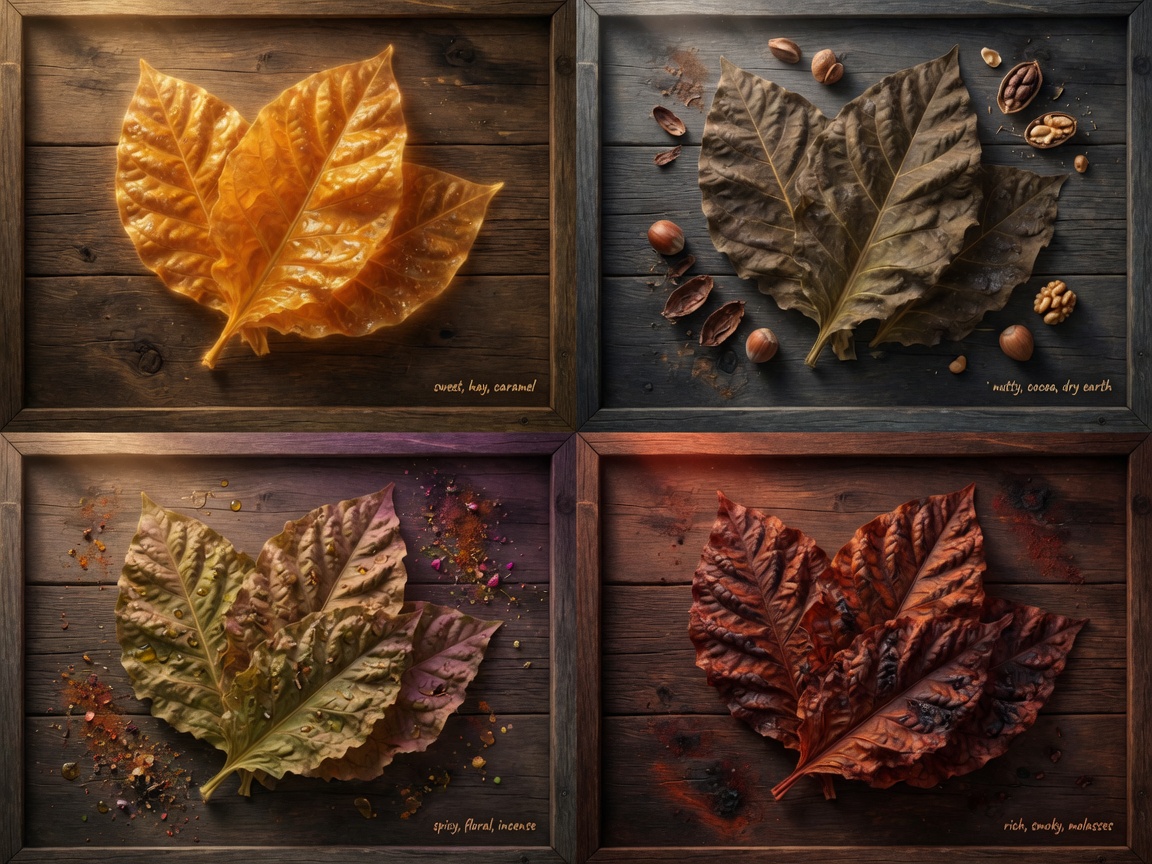
Flue-Cured, Burley, Oriental and Air/Sun-Cured Tobacco: Composition and Flavor Differences
Many people first encounter tobacco raw material information and are easily led astray by brand stories, origin legends, and claims like "this one is smoother, that one is stronger." What truly determines the structural style of a cigarette (or a leaf blend) is often the **tobacco type**: flue-cured, burley, oriental, and the broader air/sun-cured categories. Differences in cultivation method, leaf physiology, and curing path directly show up in the spectrum of sugars, nicotine, nitrogenous compounds, organic acids, and aroma compounds, which then become the strength, sweetness, irritation, and flavor family you perceive.
This article is for readers who want to understand tobacco raw materials, systematically comparing four types of material along "cultivation characteristics → chemical composition → final taste." First, let us state our position clearly:
- **This is raw material science, not a cigarette-buying guide.** Any combustible tobacco product produces tar, carbon monoxide, multiple carcinogens, and irritant gases.
- **"Air/sun-cured tobacco" is not an alias for burley.** Burley is a large industrial category among air-cured tobaccos; "air/sun-cured tobacco" in this article mainly refers to traditional sun-cured types (sun-cured red, sun-cured yellow, etc.) and non-burley local air-cured leaf.
- **Type provides the big framework; variety, stalk position, growing region, fertilization, and curing rewrite the details.** This article uses "typical trends" to avoid reading it as the only standard answer.
1. What the Four Tobacco Types Are
| Type | English/industry term | Core curing path | Common industrial role |
|---|---|---|---|
| **Flue-cured** | Flue-cured | Controlled temperature and humidity in bulk barn: yellowing—color fixing—stem drying | Main body of most cigarette blends; sweet/roasty framework |
| **Burley** | Burley (air-cured) | Natural or semi-controlled air curing in barns | "Strength and framework" material in blended cigarettes, often cased |
| **Oriental** | Oriental / Turkish type | Small leaf, mostly sun-cured | Volume may be small, but style contribution is prominent (spicy, resinous) |
| **Air/sun-cured** (this article's scope) | Air/sun-cured traditional types | Sun curing or local air curing | Cigar filler, local specialty tobacco, some traditional products |
1. Flue-cured tobacco
By precisely managing temperature and humidity in the barn, curing is completed. Typical leaves, after being harvested at proper ripeness, go through yellowing, color fixing, and stem drying; the appearance is mostly lemon to orange-yellow, with oil content and luster varying by grade. Chemically, the most striking label is: **high reducing sugars, medium nicotine, well-coordinated sugar/nicotine ratio**, and the smoke is often described as relatively "full, sweet, with obvious roasted aroma." China's main producing regions are related to style zones such as Yunnan tobacco, Guizhou tobacco, and Hunan tobacco; at the variety level, Honghuadajinyuan, K326, and the Yunnan tobacco series are often discussed, but the same variety can differ greatly in composition under different ecologies.
2. Burley
Burley is an air-cured type with **stem-leaf yellowing genetics**, and in the field it often shows light-colored stem and vein features. Curing is mainly air curing: during relatively slow water loss, intense material transformation occurs inside the leaf. Its industrial image is very clear—**extremely low sugar, almost a "sugar-free" feel, with high nicotine and total nitrogen**, with a taste leaning toward strength and dryness, and a tendency toward nutty, cocoa, and roasty notes. In American-style blended cigarettes, burley is often an important piece that "supports satisfaction and smoke structure," and is therefore more often combined with casing and flavoring technology.
3. Oriental tobacco
Oriental tobacco is usually small-leafed and produced under dense planting or specific cultivation regimes, mostly distributed around the Mediterranean and similar ecologies (high temperature, strong light, relatively poor soil or specific mineral backgrounds). Curing is mainly **sun curing**. Its "sense of value" often does not come from high nicotine, but from **distinctive essential oils, resinous character, and aroma compounds**. Even at a low proportion in a formula, it can significantly change a cigarette's expressiveness, spiciness, and "oriental flavor" layers.
4. Air/sun-cured tobacco (sun-cured red, sun-cured yellow, and local types)
This is a large **process- and purpose-oriented** category rather than a single genetic variety:
- **Sun-cured yellow tobacco**: appearance and internal chemistry can sometimes approach some flue-cured features, and sugar is relatively more present;
- **Sun-cured red tobacco**: after curing, it is mostly dark brown or purplish brown, with lower sugar, stronger nitrogenous character and style, more "localized";
- **Other local air/sun-cured types**: they differ greatly depending on variety, drying yard, climate, and use (cigar, traditional local tobacco, etc.).
Therefore, the safest way to talk about air/sun-cured tobacco is: **first separate sun-cured yellow/sun-cured red/use, then discuss composition and flavor**, rather than treating it as a "single species" on par with flue-cured tobacco.
2. Cultivation Comparison: The Field Already Decides "What It Will Look Like Later"
Chemical differences are not entirely "baked out" in the curing barn; growth in the field has already laid the groundwork.
| Dimension | Flue-cured | Burley | Oriental | Air/sun-cured (summary) |
|---|---|---|---|---|
| **Leaf and plant type** | Medium-large leaves, clear layering, significant stalk-position differences | Medium-large leaves, yellowing genetics, active nitrogen metabolism | Small leaves, many leaves, special accumulation path for style substances per unit area | Varies by type; sun-cured red often has thicker leaf flesh and relatively fewer leaves |
| **Ecological preference** | Suited to coordinated light, temperature, water and fertility; emphasizes "proper ripeness" | Strong response to nitrogen; poor management easily produces crude high nicotine | Likes strong light, specific drought stress and mineral background | Mostly depends on drying-yard climate and traditional producing-region experience |
| **Fertilization logic** | Pursues sugar/nicotine balance; excess nitrogen hurts aroma and color | High inherent nitrogen potential; water and fertilizer decide "kick" and off-notes | Usually does not rely on heavy water and fertilizer to pile up yield and nicotine | Large local differences; sun-cured red systems often lean "strong" |
| **Harvest** | Mostly harvest one mature leaf at a time (in batches) | Can be batched or combined with maturity management | Small-leaf characteristics affect harvest rhythm | Both batch and single harvest traditions exist |
| **Field goal** | Aroma quality, oil, body, usability | Body, filling power, nicotine, usability | Aroma concentration and typical oriental style | Color, body, burning, and local style |
Three key points when reading the table
- **Upper vs. lower leaves**: in almost all types, upper leaves often have higher nicotine and greater irritation potential; middle leaves are often more "usable." Type comparison cannot ignore stalk position.
- **Nitrogen is the watershed**: burley and many air/sun-cured systems are more "sensitive" to nitrogen; excessive nitrogen in flue-cured easily lowers sugar and raises off-notes; oriental style does not rely on piling up nitrogen.
- **Drought and light**: the classic oriental style is highly related to ecological stress and strong light; flue-cured emphasizes controlled ripening and coordinated baking.
3. Curing: The Key Step That Rewrites "Green Leaf" into "Usable Tobacco"
The same leaf, whether flue-cured, air-cured, or sun-cured, can end up with a completely different chemical spectrum. Industry research has even done experiments swapping the curing paths of flue-cured and burley: sensory style and the proportions of aroma substances change accordingly—showing that **curing is not an attached process but a component shaper**.
1. Flue-cured: quickly "locking in" sugar and color
The barn path roughly goes:
- **Yellowing**: chlorophyll degrades, yellow shows, starch-to-sugar conversion is active;
- **Color fixing**: raise temperature, lower humidity, and "fix" the formed color and soluble components;
- **Stem drying**: the midrib is fully dried, convenient for storage and processing.
The result: more reducing sugars are retained, forming the signature sweetness and roasted aroma base of flue-cured; it also demands precise process control—fixing color too early or too late sacrifices aroma or produces green off-notes, scalded patches, and other problems.
2. Burley: "sugar consumption and nitrogen metabolism" during slow air curing
During air curing, the leaf continues respiration and enzymatic transformation, **sugars are largely consumed**, and the nitrogenous compound system becomes more prominent. This is why burley is almost famous for "low sugar and high nitrogen." Slow water loss also shapes its characteristic natural aroma tendency (nutty, cocoa, woody/roasty descriptions are common), and brings a more obvious dryness and strength. Industrially, casing is often used to restore some sweetness and balance.
3. Oriental: the "concentrated style" of sun curing and small-leaf structure
Sun curing depends on sunlight and day-night temperature and humidity changes, a process that is relatively "weather-dependent plus experience-based." Small leaves, a high surface-to-volume ratio, and secondary metabolism under specific ecologies make oriental tobacco more recognizable in essential oils, resinous character, and spicy precursors. Nicotine may not be high, but the **aroma contribution per unit of usage** can be very high.
4. Air/sun-cured: from sun-cured yellow to sun-cured red, two sensory paths
- **Sun-cured yellow path**: closer to some "color- and sugar-preserving" logic; composition can approach flue-cured (still not flue-cured);
- **Sun-cured red path**: deeper color, more thorough transformation, lower sugar, heavier style, with a common dark appearance and strong local aroma.
4. Systematic Comparison of Chemical Composition
The following are **typical trends**, not absolute numbers from a single laboratory measurement. Actual tobacco leaf fluctuates greatly by stalk position, grade, year, and producing region.
| Component/Indicator | Flue-cured | Burley | Oriental | Air/sun-cured (sun-cured yellow/red summary) |
|---|---|---|---|---|
| **Nicotine** | Medium | Medium-high to high | Low-medium | Medium to high (sun-cured red and local types are often not low) |
| **Total sugar / reducing sugar** | High | Extremely low | Low-medium to medium | Sun-cured yellow can be high; sun-cured red often low |
| **Sugar/nicotine ratio** | Relatively high, with good mellowing potential | Very low; strength and irritation easily stand out | Depends on the blend; style is prioritized over "sweetness" | Varies greatly; sun-cured red is often low |
| **Total nitrogen / protein-like** | Medium | Relatively high | Low-medium to medium | Often relatively high or structurally different |
| **Organic acids** | Relatively high, supporting mildness and sweet-aroma coordination | Different spectrum, coupled with strength | Coexist with essential oils, distinct style | Varies with curing |
| **Polyphenols** | Medium-high, related to color, astringency, and some aroma | Has a characteristic phenolic spectrum | Interwoven with aroma substances | Changes significantly after curing |
| **Aroma substance impression** | Roasty, sweet, clean-sweet/scorched-sweet | Nutty, cocoa, roasted, dry natural aroma | Spicy, fatty, resinous, expressive | Strong local style; rich or rustic |
| **Burning and filling (summary)** | Body and burning affected by potassium, chlorine, and tissue structure | High filling power and formula framework value | Small usage but high flavoring value | In cigar filler and other scenes, burning and structure matter |
1. Nicotine: the same coin of satisfaction and dependence
Nicotine is the main alkaloid, determining physiological strength and serving as the core pharmacological basis of addiction.
- **Flue-cured**: middle ripe leaves are often in the "usable" medium range; upper leaves can rise noticeably.
- **Burley**: a typical high-nicotine tendency, an important source of "strength" in blends.
- **Oriental**: many samples are not high in nicotine, yet change overall perception through aroma.
- **Air/sun-cured**: sun-cured red and local rich types can be very high; do not assume "traditional = mild."
**Sensory translation**: high nicotine is not necessarily "flavorful," but tends to be "harsh, potent, with strong throat presence"; the free-base ratio and the acid-base environment of the smoke also affect the "speed of onset."
2. Sugars: the buffer pool of sweetness, smoothness, and off-notes
- **Flue-cured's high sugar** is the basis of its sweetness and part of its aroma precursors, and it also makes the sugar/nicotine ratio more favorable to "softness."
- **Burley is nearly sugar-free**, with a drier, more direct natural aroma; industry often relies on casing to restore balance.
- **In oriental, sugar is not the protagonist; the aroma spectrum is.**
- **Sun-cured yellow can have sugar, sun-cured red often has little**—this is also one reason the two diverge in taste.
Note: **high sugar does not mean safer**. The risk after burning is not decided by "how sweet it is."
3. Total nitrogen and nitrogenous compounds: amplifiers of strength, off-notes, and irritation
Burley and many air/sun-cured types have relatively high total nitrogen; the risk of irritating nitrogenous pyrolysis products in smoke is higher, and dry mouth and throat scratchiness are more likely. Flue-cured pursues nitrogen-sugar coordination; excessive nitrogen directly harms usability.
4. Organic acids and polyphenols: smoothness, astringency, and color
Organic acids participate in the smoke's acid-base balance and smoothness; polyphenols are related to color, astringency, and part of the aroma. Flue-cured's "smooth," burley's "dry," and oriental's "transparent" are all explained by these secondary but crucial component spectra rather than by a single nicotine number.
5. Aroma substances: the "fingerprint" of type style
- Flue-cured: a sweet-roasty system formed by curing;
- Burley: nutty/cocoa/roasty descriptions related to air curing are more common;
- Oriental: essential oils with spicy, fatty, resinous character;
- Air/sun-cured: local characteristic aroma, spanning a wide range from rich to rustic.
Some research has compared the aroma components of Yunnan flue-cured, oriental, and burley tobacco; the types of compounds detected and the dominant components are not the same—this chemically supports that "the three types of material cannot be simply interchanged in a formula."
5. Flavor and Taste: From Smoke Structure to Typical Aroma
Now translate the chemistry above into the smoking experience (still a summary; individual differences and product design rewrite everything):
| Sensory dimension | Flue-cured | Burley | Oriental | Air/sun-cured (summary) |
|---|---|---|---|---|
| **Strength** | Medium; can rise with upper leaves | Relatively strong | Often not strong, but presence can be "sharp" | Sun-cured red/local types can be strong |
| **Sweetness** | Obvious (high-sugar basis) | Weak; often needs casing | Not necessarily sweet; many aroma layers | Sun-cured yellow can have it; sun-cured red often weak |
| **Irritation** | Low when coordinated; rises with upper leaves | Throat/dryness more easily stand out | Spicy irritation differs from "high strength" | Varies greatly; rich types are higher |
| **Aroma keywords** | Roasty, clean-sweet, scorched-sweet, honey notes | Nutty, cocoa, roasted, woody dry aroma | Spicy, fatty, floral/resinous, expressive | Local rich aroma, mellow or rustic |
| **Smoke form impression** | Relatively "full," "round" | Relatively "hard," "supporting" | Relatively "floating," "cross-aroma" | From mellow to fierce |
| **Aftertaste** | Sweet residue and roasted residue | Dry, strong, natural aroma residue | Aroma residue longer than "sweetness" | Strong style residue |
A "causal chain" diagram (easy to remember)
Why is "the same blended cigarette" so complex?
Industrial blended cigarettes are often:
- **Flue-cured** provides sweet aroma and overall fullness;
- **Burley** provides strength, framework, and part of the natural aroma;
- **Oriental** provides expressiveness and oriental flavor accents;
- Then expanded leaf stems, reconstituted tobacco, casing/flavoring, and filter design are added.
So what you feel is not "the taste of one tobacco type," but **the result of formula engineering**. Understanding the four types separately is for reading the language of formulas, not for reducing everything to a "pure-leaf myth."
6. Role Differences in Use (Raw Material Perspective)
| Use scenario | More common material logic |
|---|---|
| **Flue-cured cigarette** | Flue-cured as the main body, emphasizing style-zone features such as clean aroma/rich aroma |
| **Blended cigarette** | The classic triangle of flue-cured + burley + oriental, plus casing and flavor |
| **Cigar** | Relies more on air/sun curing and specific fermentation systems; different from the flue-cured logic of cigarettes |
| **Traditional local tobacco / specialty products** | Sun-cured red, sun-cured yellow, or local air-cured types contribute a strong regional style |
| **Casing dependence** | Burley is the highest (industry practice); flue-cured relies more on natural aroma and usability |
Repeatedly emphasized: describing use is not recommending use. Understanding use is to understand "why the composition looks like this."
7. Correcting Common Misconceptions
- **"Oriental has low nicotine, so it is safer"**
Wrong. Nicotine is only part of the risk; combustion products, frequency of use, and inhalation method are equally critical. Low nicotine does not equal low harm.
- **"Flue-cured is sweet, so it has less tar"**
Wrong. Sweetness comes from sugar and aroma impression, and there is no simple "sweeter means less tar" relationship with tar yield.
- **"Burley is air/sun-cured tobacco"**
Inaccurate. Burley is a standardized industrial type among air-cured tobaccos; air/sun-cured tobacco also includes a large number of sun-cured red, sun-cured yellow, and local types.
- **"A certain variety is inherently the best/worst"**
Over-simplification. Type sets the framework; producing region, stalk position, maturity, and curing determine the final usability.
- **"Traditional air/sun curing = natural = harmless"**
A dangerous misunderstanding. Traditional processes change style and the composition spectrum, but do not cancel combustion toxicity.
- **"Composition tables can directly guide me to blend my own leaf"**
This article provides no operational advice for DIY or regulatory circumvention. Industrial formulas also involve regulations, burning safety, and quality control, far beyond reading composition tables.
8. Health Perspective: Understanding Raw Materials Does Not Dissolve Risk
From the nasal cavity, oral cavity to the bronchi and cardiovascular system, particles, carbon monoxide, aldehydes, polycyclic aromatic hydrocarbons, tobacco-specific nitrosamines, and more in tobacco smoke all cause damage. The raw material type can change **style and part of the exposure profile**, but no category of combustible tobacco can be described as an "acceptable everyday consumer product."
If your motivation for reading this article is to understand dependence, prepare to quit, or recognize marketing language:
- **Nicotine** explains why it is hard to stop;
- **High-nitrogen/irritating materials** explain why some people feel "harsh, dry, heady";
- **Casing and flavoring** explain why "tastes good" is not "low harm."
The truly risk-reducing path is **stopping the use of tobacco products**; medical paths such as nicotine replacement therapy should be used under formal guidance, rather than replacing quitting with "switching to another tobacco type."
9. Conclusion
Flue-cured, burley, oriental, and air/sun-cured tobacco are not four "taste labels," but four (and more subsets of) complete technical systems from field to curing:
- **Flue-cured**: high sugar, medium nicotine, roasty-sweet and smooth, the main body of cigarettes;
- **Burley**: low sugar, high-nitrogen/high-nicotine tendency, strength and framework, often needs casing for balance;
- **Oriental**: a style-oriented small-leaf sun-cured tobacco, spicy and fatty, high flavoring value;
- **Air/sun-cured**: the traditional sun-cured red/yellow spectrum, with a wide composition range and strong local style.
String "cultivation characteristics—chemical composition—taste and flavor" into one chain, and you can understand those mystical industry words: mellow, expressive, body, off-notes, filling power, sugar/nicotine ratio. The next time you see "some producing region, some type," first ask three questions: Is it flue-cured, air-cured, or sun-cured? Where do sugar and nicotine roughly stand? Does it serve as the body, the framework, or the flavor accent in the formula?
Understanding materials is to understand more clearly how tobacco products are designed—and to understand more clearly their health costs.
*This article is tobacco raw material science and does not constitute any usage advice. For smoking cessation and health questions, please consult a qualified medical institution or a local smoking cessation service.*