The core task of a cigar blender is to precisely control the proportions of Ligero, Seco, and Volado leaves to regulate burn rate and nicotine delivery. This article explores this technical process from three dimensions: physical structure, combustion dynamics, and practical recipes.
How the Proportion of Tobacco Leaves from Different Positions in Cigar Filler Technically Adjusts Burn Time and Strength
Preface: The Art of Proportion, Not Mere Stacking
In the late autumn of 2012, the air in Esteli, Nicaragua, was filled with a heavy, almost oppressive, fermented sweetness. That was the first time I truly stood before a blending table, not as an observer. I was trying to optimize a medium-strength cigar for the North American market, and I mistakenly believed that using the finest, oiliest Ligero leaves would naturally produce a stunning final product.
The result was disastrous.
Those cigars burned like an uncontrolled wildfire during testing: extremely fast, the smoke scorching hot, and quickly becoming hollow after the first third, completely lacking any structural integrity. In that moment, I realized cigar blending is not a simple addition of good ingredients, but a precise game of proportions, physics, and chemical balance. The filler ratio essentially controls the dynamic balance between fuel and oxygen in the combustion process, as well as the rate of nicotine release.
Chapter 1: The Trinity of Filler — Dissecting the Physical Soul of Tobacco Leaf
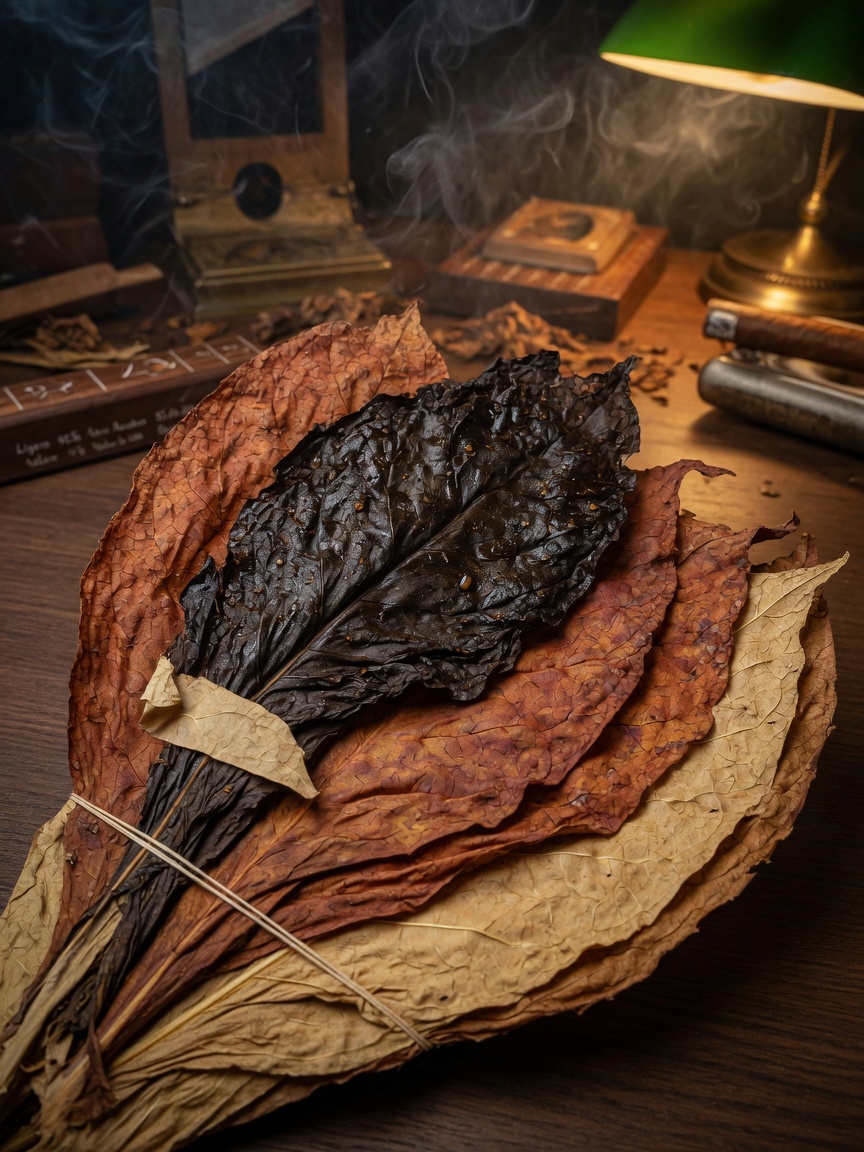
To understand the magic of proportions, one must first dissect the tobacco leaf. In each tobacco plant, due to differences in light exposure, nutrient distribution, and hormones, the leaves exhibit distinctly different characters.
1. Ligero: The Engine of Combustion and the Source of Strength
Ligero grows at the very top of the tobacco plant, the part that receives the most sunlight. This gives it an extremely thick leaf structure and very high oil content. Chemically, Ligero is a warehouse of nicotine, with concentrations far exceeding those of other positions.
In blending, Ligero is the core that gives a cigar its punch. However, its physical characteristics also present challenges: due to its richness in oils and thick structure, it generates extremely high heat during combustion. If the proportion is excessive, too much Ligero can lead to excessively high combustion temperatures, which not only burns away the aromatic compounds in the leaf but also makes the smoke exceptionally harsh, even producing an unpleasant burnt bitterness.
2. Seco: The Soul of Flavor and the Bridge of Balance
Seco grows in the middle of the plant. It possesses neither the wild power of Ligero nor the lightness of the lower leaves. It carries the cigar's richest aromatic spectrum, from nutty and chocolate notes to subtle earthy tones.
Technically, Seco has moderate oil content and a relatively stable burn rate. It is the binder in the blend, responsible for establishing a transition between Ligero's strength and Volado's structure. A master blender's skill is often evident in the fine-tuning of the Seco proportion, determining whether the cigar leans towards a steady, profound character or a lighter, more airy aroma.
3. Volado: The Skeleton of Structure and the Pacemaker of Combustion
Volado grows at the very bottom of the plant. Having long been in the shade, its leaves are relatively thin, with the lowest nicotine and oil content.
Although it seems delicate, Volado is an indispensable skeleton in the filler system. It determines the cigar's combustion rhythm. Because the leaves are thin and relatively drier, Volado provides good air circulation for the combustion process, ensuring a smooth, slow burn, preventing the cigar from going out or burning unevenly due to excessive oils. It is key to maintaining the cigar's structural integrity and ensuring a smooth draw.
Chapter 2: Combustion Dynamics — How Proportions Control Time and Strength
At the blending table, we are not just mixing leaves; we are manipulating a complex set of physical and chemical reactions. To understand the true meaning of proportion, one must approach it from the perspective of combustion dynamics.
1. The Chemical Nature of Strength: Nicotine and Oil Release Rates
When we talk about cigar strength, we usually refer to two dimensions: the physiological impact from nicotine and the sensory thickness the smoke delivers to the palate.
Nicotine release is directly controlled by the Ligero proportion. However, a common misconception is that more Ligero equals higher strength. The reality is not that simple. True strength comes from the continuity of nicotine release. If the Ligero proportion is too high, the smoke becomes extremely sharp due to excessive heat, creating a short and unpleasant impact.
At this point, we need to increase the Seco proportion to introduce more oils. Oils not only coat the nicotine, slowing the intensity of its release, but also make the smoke more round. A masterful blend allows nicotine to surge towards the senses like a tide, gently and persistently, as the burn progresses, rather than exploding and taking your breath away instantly.
2. The Physical Nature of Burn Rate: Heat Conduction and Oxygen Flow
Burn rate is essentially a competition between the rate of fuel consumption and the efficiency of oxygen supply.
In 2015, I encountered a tricky problem: a cigar for the European market received customer feedback that it burned too fast, causing the flavor to become dry and harsh by the time it was one-third smoked. I checked the recipe and found that, in pursuit of so-called flavor thickness, I had reduced the Volado proportion to below 15 percent. This made the filler layer too dense, preventing heat from dissipating effectively, causing the cigar to burn like a compressed bundle of dry grass. Later, by increasing the Volado by 10 percent and combining it with an appropriate amount of Seco as a buffer, I successfully extended the burn time by nearly 15 minutes and resolved the dryness issue.
Chapter 3: Technical Levers — The Blender's Manipulation Tools
As a blender, the main levers at our disposal are three: proportion, moisture content, and tobacco processing techniques.
1. The Proportion Lever: Building a Sense of Layering
We need to establish a layered structure. A classic filler structure with good layering generally follows this logic:
By changing the relative proportions of these three, we can precisely position the product in the light, balanced, or full-bodied range.
2. The Moisture Lever: Controlling the Brake of Combustion
If proportion determines the potential of combustion, then moisture content determines the braking force. During the blending stage, we differentially treat leaves from different positions.
For example, we maintain a slightly higher moisture content in Ligero, using the latent heat of water evaporation to offset the high temperatures generated by its combustion, thereby slowing the burn rate. For Volado, we tend to use lower, more uniform moisture levels, to ensure its function as a vent is not compromised by excessive dampness. This precise control of moisture is the dividing line between factory assembly line products and masterpiece cigars.
Chapter 4: Recipe Practice — From Theory to Fingertips
At the blending table, theory must ultimately translate into precise numbers. The quality of a recipe lies not in how many expensive leaves are used, but in the synergistic effects between leaves from different positions. Below, I will share two representative recipes, representing two distinctly different blending philosophies.
Case 1: High Strength, High Impact — The Dark Night Profile
This recipe was developed in 2018 for a full-bodied series targeting high-end cigar enthusiasts. The goal was to provide an extremely strong nicotine impact and a deep flavor profile of dark chocolate and leather.
Recipe Structure
Blending Logic and Technical Details
1. Controlling High Ligero: A 55 percent Ligero ratio is extremely dangerous and can easily lead to the combustion getting out of control. To tame this power, I specifically chose leaves that underwent long, low-temperature slow fermentation. The goal was to chemically degrade the tarry sensation while preserving the nicotine strength.
2. Seco Flavor Anchoring: The 30 percent Seco is not just for balance; it is for introducing thickness. I selected Seco leaves with extremely high oil content, aiming to lock in the signature chocolate aroma through the volatilization of oils within the heat generated by Ligero.
3. Minimal Volado Structure: With Ligero accounting for a very high proportion, Volado is compressed to 15 percent. The key here is that the chosen Volado must possess extremely high fiber integrity. If the Volado quality is subpar, the cigar's structure will collapse by the middle of the burn, making it unsmokable.
Problems Encountered and Solutions
In the initial trial, this recipe exhibited obvious heat overload at about 40 percent burn progress, with the smoke becoming extremely harsh and even stinging the throat.
Case 2: Balanced, Elegant — The Morning Dawn Profile
This recipe aims to create an all-day cigar suitable for mornings, with an elegant flavor and distinct layering. It pursues a flowing aroma rather than a single dimension of strength.
Recipe Structure
Blending Logic and Technical Details
1. Seco-Centric Aroma Architecture: The 50 percent Seco ratio is the soul of this cigar. Through this high proportion of Seco, I made the tobacco's aroma — cream, hay, subtle floral notes — the absolute protagonist.
2. Low-Strength Ligero Support: The 25 percent Ligero serves only as an energy background. It does not provide impact, but rather a subtle, supportive thickness, ensuring the smoke does not feel too light and airy.
3. Double Volado Stability: The 25 percent Volado ensures excellent combustion rhythm. The characteristic of this cigar is its slow burn, maintaining a stable burn line even when smoked relatively quickly, which is crucial for enhancing the user experience.
Practical Insights
The main challenge of this recipe lies in the cohesion between layers. If the Seco quality is inconsistent, the smoke can exhibit a disjointed sensation — fragrant at times, then suddenly flat and unremarkable. During blending, I require farmers to grade the Seco, ensuring that every batch entering the blending table has oil content and aroma concentration within an extremely narrow standard range.
Chapter 5: Blending Philosophy — Between Data and Intuition
If someone asks me what the hardest part of blending cigars is, I will tell them: it is not understanding the complex proportion data, but learning how to listen to one's intuition.
A great blender must find a balance between rigorous scientific logic and sensory intuition. You need to calculate the ratio of every gram of tobacco as precisely as a chemist. But when you face that slowly rising smoke, carrying the soul of the cigar, you must feel its story like a poet.
This intuition is, in fact, something that settles into muscle memory through countless failures, countless burnouts, and countless late nights pondering over tobacco aromas.
Conclusion: The End of Proportion is the Resonance of the Soul
Returning to our original question: how does proportion technically adjust burn time and strength?
The answer lies not only in the physical control of burn rate or the chemical management of nicotine release. The true meaning of proportion is in the precise orchestration of the characteristics of tobacco leaves from different positions, constructing a sensory world with vitality that evolves over time.
A perfect proportion allows a cigar to display surging power upon lighting, delicate layering in the middle, and maintain an elegant aftertaste at the end. This is the highest art a blender can achieve through proportion.
Comparison of Two Blending Philosophies
Dark Night Profile — High Strength, High Impact
55% Ligero delivers extreme nicotine impact, ideal for experienced cigar enthusiasts seeking robust flavor. Fast burn with intense, deep character.
Morning Dawn Profile — Balanced, Elegant
50% Seco core with distinct creamy and floral layers. Slow, even burn ideal for all-day smoking with an elegant, refined palate.
※ Note: Proportion data based on typical blending formulas; actual production requires fine-tuning per tobacco batch.