The "personality" of tobacco leaf is first a chemical ledger, not an origin legend: six axes — alkaloid, sugar, acid, phenol, nitrogen, mineral — decide sweet, sharp, astringent, or "empty."
The tens of thousands of smoke constituents newly formed in combustion are another, dirtier ledger; this article touches on them only when necessary.
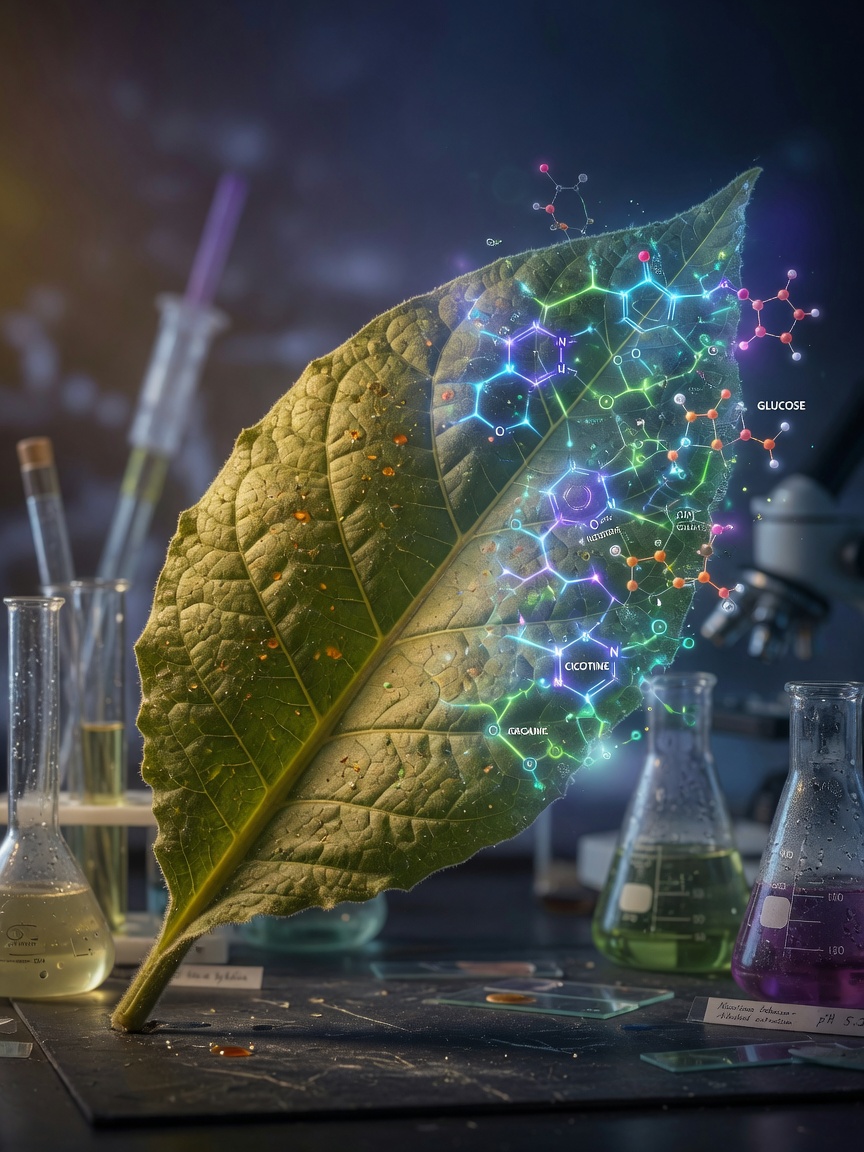
Tobacco Leaf Composition: Nicotine, Sugars, Organic Acids, Phenolics, and More
One Wednesday afternoon in November 2023, inside the laboratory of a medium-sized re-drying plant near Yuxi, Yunnan, the air conditioner held the room at 22°C. On the bench sat freshly ground mid-leaf powder, with a batch number and "C3F" written on the paper bag. The technician weighed the sample to 0.5 g and ran the routine tests: total sugar, reducing sugar, total alkaloids, total nitrogen, potassium, and chlorine. Forty minutes later, the printout came out: reducing sugar about 22%, total sugar about 26%, nicotine about 2.4%, total nitrogen about 1.9%. My first reaction was not "will this tobacco taste good," but rather: this sheet of paper is really describing a set of molecules competing with one another — who has more and who has less will directly determine whether your mouth feels sweet, sharp, astringent, or "empty."
Later, I stacked these lab reports together against trial-smoking notes and slowly formed a private view: <strong>the "personality" of tobacco leaf is first of all a chemical ledger, not a legend of origin.</strong> Origin, variety, and curing are just ways of rewriting the ledger. Below, I break this ledger open by major component groups — first discussing what is naturally in the leaf, then how processing rewrites it. The tens of thousands of smoke constituents newly generated during combustion are another, dirtier ledger; this article touches on them only when necessary.
I. First, put "what is in tobacco leaf" on a rough table
Within the dry matter of mature leaf, what is commonly grouped under "routine chemical constituents" roughly includes:
| Category | Rough magnitude (dry basis; varies greatly with variety, part, and process) | Common sensory contribution |
|---|---|---|
| Carbohydrates (sugars, starch, cellulose, etc., combined) | Often around half of dry weight | Sweetness, filling, precursors of burnt-sweet/roast aroma |
| Alkaloids (mainly nicotine) | Total alkaloids about 0.5%–10%+; cigarette leaf mostly at roughly 1%–3% | Physiological strength, throat impact, core of addiction |
| Organic acids (malic, citric, oxalic, etc.) | Non-volatile acids considerable; varies by type | Smoothness, sourness, salt formation with bases |
| Polyphenols/flavonoids and other phenolics | About 1.8%–5% of dry weight, a common range | Color, bitterness, some aroma precursors |
| Nitrogenous compounds (protein, amino acids, total nitrogen) | Total nitrogen often at 1%–3% | Strength, off-aroma, Maillard raw material |
| Minerals (K, Cl, Ca, Mg, etc.) | Potassium common at percent level; excess chlorine means "dirty" | Burnability, off-flavor, irritation |
| Pigments, lipids, resins, etc. | Chlorophyll, carotenoids, etc., change drastically with maturity and curing | Appearance and aroma precursors |
Literature and industry sources repeatedly note: aroma-related substances in tobacco can be broken down to the hundreds, while measurable components of the whole plant/whole leaf reach thousands. For someone writing about raw materials, remembering "thousands" is less useful than remembering <strong>five or six main axes that constrain one another.</strong> My habit: alkaloid, sugar, acid, phenol, nitrogen, mineral — read these six axes first, then discuss details.
II. Alkaloids: nicotine is not "just a little seasoning"
1. What it is and how much there is
The chemical marker that distinguishes tobacco from most food crops is pyridine alkaloids. Among them, <strong>nicotine usually accounts for more than nine-tenths of total alkaloids</strong> (commonly expressed as >90%–95%), with the rest including nornicotine, anatabine, anabasine, and others.
The content range spans widely:
- Low-alkaloid leaf can be below about 0.5%;
- High-alkaloid material can reach several percentage points, and even higher extremes appear in the literature;
- <strong>Typical cigarette leaf</strong> mostly falls in the working range of about 1%–3% (dry basis); some sources cite "cigarette tobacco around 1.5%" as an indicative value.
In 2022, at a tobacco station in Guizhou, I compared samples of different stalk positions of the same variety: nicotine in upper leaves was clearly higher than in middle leaves, and middle leaves higher than lower leaves. After topping, the apical dominance is cut off and nicotine accumulates toward the leaves — this is not mysticism; it is field operations directly rewriting the chemistry.
2. How it "stands" in the leaf
Much of the nicotine in the leaf exists in <strong>salt form combined with organic acids</strong>, not always in "free" form. Under heating and combustion, part converts to free nicotine, and volatility and irritation change with it. This is also why the same nicotine number, at different pH and in different acid environments, can smoke very differently in "punch" — the number is only half a map.
3. The pit I stepped into
In the summer of 2021, at home I used a cheap electronic scale and "high-nicotine cut tobacco" bought online to make a small-ratio blend (only as a control experiment — I do not advise anyone to imitate it), aiming to lift the strength of a batch of "hollow-feeling" leaf. The first cigarette made my throat tighten and head dizzy; I gave up on the second. Later, cross-checking the supplier's lab report: nicotine close to 3.5%, reducing sugar only about 8%. <strong>High alkaloid, low sugar — this is textbook "sharp and dry."</strong> My mistake then was looking at only one number, nicotine, without looking at the sugar-to-alkaloid ratio.
My personal view is clear:
- <strong>Nicotine is the core molecule of physical dependence</strong>; when discussing "aroma" and "strength," it cannot be romanticized;
- For judging raw material, <strong>looking at nicotine's absolute value alone is not enough — it must be read together with reducing sugar, total nitrogen, and organic acids</strong>;
- During curing and fermentation, alkaloid levels can drop by roughly a third to half (depending on processing) and produce a series of degradation products — so "fresh leaf high in alkaloid" does not mean "finished product is necessarily sharper"; a chain of variables sits in between.
III. Sugars and carbohydrates: the chassis of sweetness and the ammunition depot of aroma
1. How much there is
Carbohydrates are the bulk of tobacco leaf dry matter. Common statements in research and reviews include:
- Total carbohydrates can approach roughly the 50% level of dry weight;
- Among them, <strong>starch</strong> can hold a large share before curing (literature commonly describes a roughly 10%–30% level);
- <strong>Cellulose</strong> and other structural polysaccharides also contribute a considerable share (ranges of roughly a dozen to over twenty percent appear in different sources);
- After curing, <strong>total sugar and reducing sugar</strong> become the center of quality discussion: reducing sugar mostly refers to sugars like glucose and fructose that can directly participate in reduction reactions.
Statements that sugars occupy roughly 25%–50% of dry weight are also common in domestic research summaries of photosynthetic products. Specific to a lab report, <strong>reducing sugar at twenty-plus percentage points in flue-cured middle leaf</strong> is not rare; burley and dark air-cured leaf, by contrast, tend to be low in sugar with relatively prominent alkaloid and nitrogen — this is a type difference, not a one-size-fits-all "good versus bad."
2. What sugar does in sensory and chemistry
- <strong>Directly</strong>: part of the source of oral sweetness and a rounded smoke body;
- <strong>Indirectly</strong>: Maillard reactions, caramelization, and reactions with amino acids generate various aroma substances; glycosides, sugar esters, Amadori compounds and other "relatives of sugar" are major subjects in aroma-precursor research;
- <strong>Structurally</strong>: cellulose and hemicellulose support the leaf skeleton and also affect burn and filling value.
In 2020, near Kunming I reviewed records from a bulk-curing barn: during the yellowing stage the humidity ran high and time dragged on, starch conversion was incomplete; the color of the cured leaf was passable, but the lab showed low reducing sugar, and trial smoking was dull and flat, no sweetness. The master's words were earthy: "the sugar wasn't roasted out; however fragrant it claims to be, it's fake fragrance." Later, with the dry-bulb and wet-bulb curves tightened to the process card, the next batch from the same field saw reducing sugar rise by roughly 4–6 percentage points, and trial smoking came alive immediately. This was the first time I pinned <strong>curing operation</strong> and <strong>sugar numbers</strong> on the same causal chain.
3. Sugar-to-alkaloid ratio: more useful than two isolated numbers
In the industry, common usage:
- <strong>Sugar-to-alkaloid ratio</strong> ≈ reducing sugar (or total sugar) / nicotine
- Some also look at the <strong>nitrogen-to-alkaloid ratio</strong> and <strong>potassium-to-chlorine ratio</strong>
There is no universal "golden single value," but empirically:
- Sugar-to-alkaloid ratio too low: prone to sharp, dry, irritating;
- Sugar-to-alkaloid ratio too high: can become sweet and floating, lacking strength, smoke "soft without a spine."
When taking my own notes, I write "reducing sugar / nicotine" in the header of the trial-smoking page. It is ten times more useful than writing "tastes fairly good."
IV. Organic acids: often overlooked, yet they decide "sting or not"
1. Look at them in two categories
- <strong>Non-volatile organic acids</strong>: malic, citric, oxalic, succinic, etc. — the main body;
- <strong>Volatile organic acids</strong>: relatively low in content, but they contribute to the aroma profile.
Across different leaf types (flue-cured, air-cured, sun-cured, fire-cured), the proportions of citric, malic, and oxalic acid can differ widely. Acids forming salts with nicotine are part of the leaf's buffer system — which also explains why an "acid environment" rewrites the proportion of free alkaloid and the irritation.
2. Personal experience: acid is not an "acid-flavored seasoning"
In March 2024, I ran a cigar-aging comparison at home (constant temperature about 18–20°C, humidity 62%–65%): same model, same batch, one aged about 14 months, the other only about 4 months. The short-aged one tightened on the tongue with a slight bitterness in the tail; the long-aged one had a more "melted" acidity and less irritation. I have not built my own HPLC, so I will not claim "malic acid dropped by so much," but combining industry common sense and repeated parallel trial smoking, I am more inclined to believe: <strong>the rebalancing of acids, phenolics, and small molecules during aging often explains roundness better than "adding more sugar."</strong>
My view: <strong>talking about strength only through nicotine is a half-illiterate raw-materials view.</strong> Acid is the seat belt that pins the alkaloid down.
V. Phenolics: color, bitterness, and part of the "aroma"
1. Content and the main players
Polyphenols in tobacco leaf commonly occupy about <strong>1.8%–5%</strong> of dry weight. Major categories include:
- <strong>Phenolic acids</strong>: chlorogenic acid and its isomers (crypto-chlorogenic, neo-chlorogenic, etc.);
- <strong>Flavonoids</strong>: rutin (quercetin-3-rutinoside), etc.;
- <strong>Coumarins</strong>: such as scopoletin, etc.
Domestic sources often note: among polyphenols, <strong>chlorogenic acid and rutin can hold the largest share</strong>, with summaries like "the two together account for about 80% of total polyphenols" (fluctuating with variety and type). Chlorogenic acid, rutin, and scopoletin are repeatedly named as key phenolics affecting color, aroma, and taste.
2. How they "change face"
- During curing and baking, polyphenols can react with macromolecules and undergo enzymatic oxidation;
- Under polyphenol oxidase and peroxidase, quinones form, then react with amino acids and participate in brown material formation — <strong>post-bake color and "graying, blackening"</strong> are often tied to this chain;
- Too high: rising risk of bitter, astringent, irritating;
- Too low: smoke may be "thin," lacking necessary concentration.
In 2023, around Bijie, I compared two datasets of middle leaf: total sugar close, but the one with higher polyphenols produced a clearly more pronounced tongue astringency when trial-smoked, like drinking coarse tea steeped too long. After that, I struck half of "astringency" off the list of pure "process failure" — <strong>high background phenolics + protein-bound precipitation</strong> will write itself into the taste on their own.
3. Glycosides
The leaf also contains <strong>glycosides</strong> formed by sugars combining with phenolics. Glycosides are relatively unstable; they readily decompose during maturation, curing, and fermentation, releasing aglycones that further participate in pigment and resin changes. Understanding phenolics only as "bitter molecules" is too narrow; they are a <strong>three-way intersection of color—aroma—taste.</strong>
VI. Nitrogen, protein, amino acids: the other half of the story of strength and off-aroma
Total nitrogen, protein, and free amino acids are regular guests in routine testing and research. Rough logic:
- <strong>Total nitrogen on the high side</strong>: smoke concentration and physiological strength may rise, but off-aroma and irritation risk also go up;
- <strong>Protein on the high side</strong>: improper curing can easily bring unpleasant odor; during fermentation and aging, protein degrades into amino acids and small molecules, which in turn supply nitrogen for Maillard reactions;
- In the amino acid profile, glutamic acid, asparagine, glutamine, gamma-aminobutyric acid, etc., are often mentioned.
Sugar and nitrogen are an old pair of rivals: <strong>sugar is the "fuel of sweetness and aroma," nitrogen is the "regulating valve of strength and off-aroma."</strong> Flue-cured tobacco pursues relatively higher sugar with moderate alkaloid and nitrogen; burley follows another formula logic of low sugar and high nitrogen. Imposing "high sugar, medium alkaloid" on every tobacco leaf is using one type's aesthetic to rape another type's chemistry.
VII. Minerals and pigments: burn and "the face"
1. Potassium and chlorine
- <strong>Potassium</strong>: usually favors burning;
- <strong>Chlorine</strong>: when too high, burning suffers, flame-out occurs, off-flavor and oral discomfort rise.
The potassium-to-chlorine ratio is a quick entry point for reading burnability. At a trial-smoking gathering outside the lab in 2019, I came across a batch of samples with abnormally high chlorine: gray-black ash, easy flame-out, salty-bitter oral residue — that was not an "aroma type problem," it was a mineral problem.
2. Pigments
Fresh leaf chlorophyll is commonly described at roughly the <strong>0.5%–4%</strong> level, with chlorophyll a about seven-tenths and b about three-tenths. During maturation and curing, chlorophyll degrades, carotenoids and others change, directly deciding the visual path from green to yellow to brown, and releasing aroma precursors. Buying leaf by eye is, in essence, reading <strong>how far pigment metabolism has walked</strong>.
VIII. How these components are rewritten by processing (the background ledger is not the final state)
The leaves of the same field become different products under different processes:
| Processing path | Typical rewriting direction of the component ledger (summary) |
|---|---|
| Flue-curing (bulk/ordinary) | Starch → sugar, chlorophyll degradation, drastic changes in polyphenols and color |
| Air-curing / sun-curing | Slow enzymatic and oxidative change; sugar-alkaloid structure differs from flue-cured |
| Bulk fermentation (e.g., cigar pilón) | Under heat and moisture, protein, part of alkaloid, and polyphenols rebalance; aroma precursors released |
| Aging / curing | Slow redox and small-molecule migration; irritation often falls, layering often grows finer |
Fermentation literature often notes: macromolecules such as protein and sugars can degrade into aroma-related substances like organic acids and carbonyl compounds. <strong>So "tobacco leaf composition" has two meanings:</strong>
- <strong>The background composition at harvest</strong>;
- <strong>The attainable composition after curing—fermentation—aging</strong>.
- <strong>Look at nicotine first</strong>: the main anchor of physiological strength;
- <strong>Then reducing sugar / total sugar</strong>: sets sweetness-moisture and aroma ammunition;
- <strong>Calculate the sugar-to-alkaloid ratio</strong>: judge sharp/floating/balanced;
- <strong>Look at total nitrogen</strong>: guard against "strong but dirty";
- <strong>Look at potassium and chlorine</strong>: judge burn and off-flavor risk;
- <strong>If possible, look at polyphenols or sensory</strong>: explain astringency, bitterness, color.
- Date, place, sample part and grade
- Six numbers + two ratios (sugar-alkaloid, potassium-chlorine)
- Trial smoking: front/middle/tail, one word each for irritation, sweetness, astringency, aftertaste
- The last line only one judgment: <strong>worth entering the blend / should be aged more</strong>
- <strong>Tobacco leaf is a complex plant chemistry, not "nicotine + flavor."</strong> Nicotine matters, but sugar, acid, phenol, nitrogen, and minerals together decide whether you are "held up" or "pricked."
- <strong>Numbers must carry conditions</strong>: variety, part, region, year, and processing decide the right to interpret a number. The same "2.5% nicotine" can be two completely different tobaccos.
- <strong>Health accounting is separate</strong>: however sweet the sugar or fragrant the phenol, combustion still exposes you to harmful smoke; understanding components is for understanding raw material and processing, not to give smoking a get-out-of-jail-free card. If the goal is to break free from cigarette dependence, take proper quitting and medical advice paths, not self-comfort about "which leaf is more natural."
- <strong>For people making harm-reduction or alternative products</strong>: leaf background and aerosol delivery are two separate systems. Equating "tobacco composition" with "safer product" does not hold logically.
- Measurable components in the leaf can reach the <strong>thousands</strong>, but for daily use the <strong>alkaloid—sugar—acid—phenol—nitrogen—mineral</strong> six axes suffice.
- <strong>Nicotine usually accounts for >90% of total alkaloids</strong>; cigarette leaf mostly in the <strong>1%–3%</strong> working range.
- Carbohydrates can approach <strong>half</strong> of dry weight; starch and cellulose are the big blocks; after curing watch <strong>total/reducing sugar</strong>.
- <strong>The sugar-to-alkaloid ratio</strong> predicts sharpness and sweetness better than nicotine alone.
- Organic acids hold much of the nicotine in <strong>salt form</strong>, affecting irritation.
- Polyphenols about <strong>1.8%–5%</strong>; <strong>chlorogenic acid and rutin</strong> are the leading players.
- Total nitrogen and protein govern "strength and off-aroma"; among minerals <strong>potassium helps burn, chlorine makes trouble</strong>.
- Curing, drying, fermenting, aging <strong>rewrite the background ledger</strong>; the final product is not a photocopy of fresh leaf.
Writing raw-material science but only the fresh leaf is like introducing flour without introducing the oven.
IX. How I read a lab report (you can follow directly)
Suppose you have the routine six items (or similar):
Operating suggestions (my own notebook format):
For that Yuxi C3F sample in 2023, my note read: "2.4 alkaloid / 22 reducing sugar → sugar-alkaloid ratio about 9.2; nitrogen 1.9 acceptable; trial smoking: clear sweetness in the middle, slightly dry tail. Could serve as a main component; better not to blend in more high-alkaloid scraps." Later the small blend took 10% high-alkaloid upper leaf, and the tail immediately tightened — the ledger does not lie.
X. Reading the components back to "people": whose side I stand on
At this point, my personal position can be stated clearly:
XI. Eight "anchors" for memory
If you take away only the minimum information, I suggest anchoring these eight:
The composition of tobacco leaf, in the end, is: the plant writes a first draft in the field, processing revises a second draft in the warehouse, and combustion (if it happens) destroys most of it in seconds and generates a new draft. Only by reading the first draft do you qualify to judge the second — and only then can you, when seeing marketing talk, ask: exactly which percentage is speaking when you say "natural"?
Background composition at harvest: initial readings of the six axes — alkaloid, sugar, acid, phenol, nitrogen, mineral
Reachable composition after curing—fermentation—aging: the same field can become different products
Note: figures are dry-basis approximations; actual values vary with variety, part, region, year, and processing.
Note: kanji/hanja retained in Japanese/Korean are legitimate script in those languages, not Chinese remnants.