Misled by "Harm Reduction": The Respiratory Tract — From Cigarettes and E-cigarettes to Snuff, a Silent Battle Between the Nasal Cavity and the Lungs
In the world of those trying to quit smoking, there is a widespread "compensatory psychology".
Old Zhang is a "heavy smoker" with thirty years of smoking history. Three years ago, he bought into the so-called "harm reduction" logic, decisively threw away his traditional cigarettes, and turned to heated tobacco products (HNB) and e-cigarettes. He once proudly told his friends: "There's no more black smoke now, and no more of that pungent tar smell. Isn't this better for my lungs than before?"
However, Old Zhang did not usher in the "freedom of breathing" he had expected. On the contrary, he found his nasal cavity abnormally sensitive: at the slightest exposure to cold air or dust, his nose would feel sore and runny; the lingering dry throat sensation was even more tormenting than when he smoked cigarettes. What confused him even more was that, although the violent coughing was gone, there was always an indescribable "heaviness" in his chest.
Old Zhang's experience is not an isolated case. When we talk about "harm reduction", we are often talking about a transfer of probability, not the elimination of risk. From traditional cigarettes to e-cigarettes, to heated tobacco products, and even to snuff that acts directly on the nasal cavity, this "battle" over the respiratory tract is driven by physiological mechanisms far more complex and ruthless than we imagine.
The Embers of Combustion: Traditional Cigarettes' "Heavy Blow" to the Lungs
Combustion is not the only source of harm, but it is the starting point for understanding all tobacco-related dangers.
To understand the harm of modern products, we must first examine the "classic opponent" that once ruled the world — the traditional cigarette.
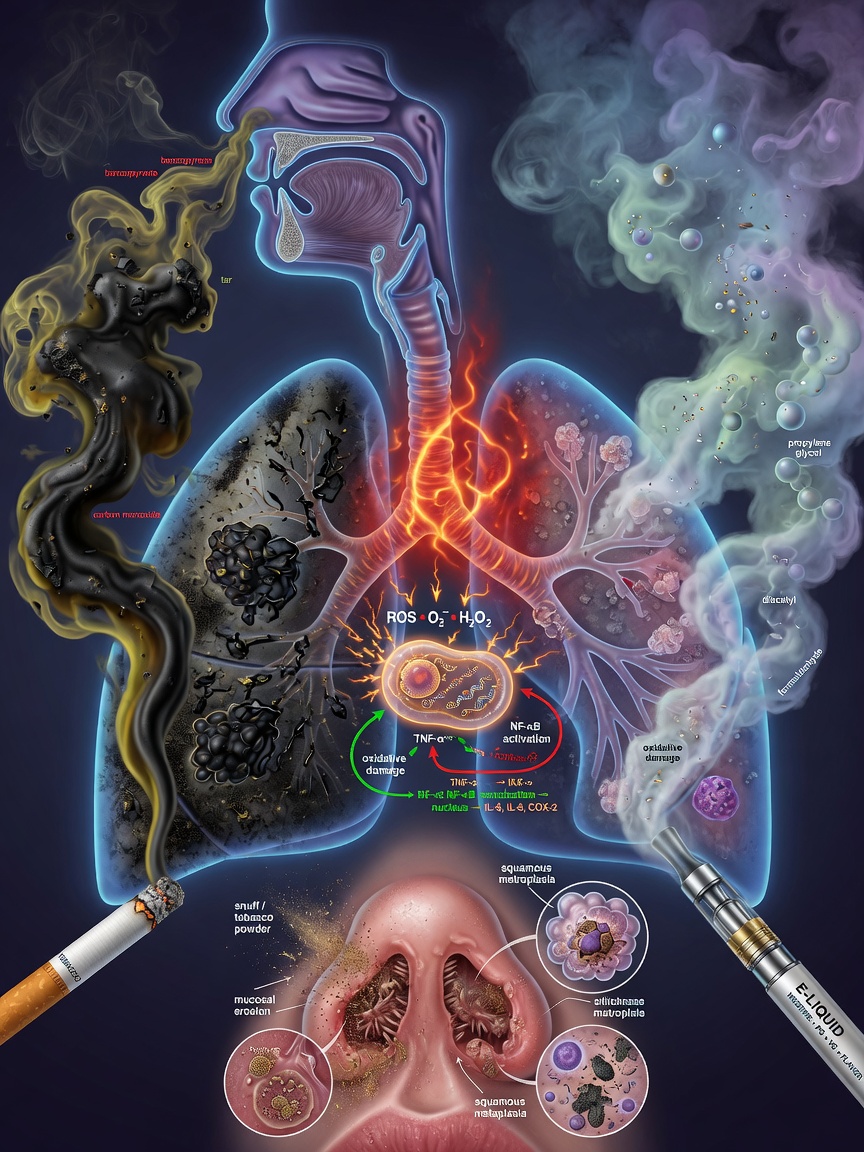
The essence of a cigarette is high-temperature combustion. When the spark touches the tobacco, the temperature instantly soars to 700°C to 900°C. In this intense thermochemical reaction, the tobacco is not only decomposed but thoroughly "reconstructed" into a complex smoke containing more than 7,000 chemical substances. The most lethal of these are tar and carbon monoxide (CO).
From an anatomical perspective, the blow of a cigarette is "all-encompassing and devastating". When a smoker takes a deep drag, these fine particles penetrate the trachea and reach deep into the alveoli. Tar is like a layer of viscous, toxic "black paint" that adheres to the alveolar surface, destroying the microscopic barrier where gas exchange between the alveoli and the blood occurs. What's worse, the oxidative stress produced by combustion overwhelms the lungs' defense system like a flood.
Traditional cigarettes trigger an intense inflammatory response in the lungs by generating large amounts of reactive oxygen species (ROS). This inflammation is not sudden; it is a slow and continuous "remodeling" process: the alveolar walls thicken, elastic fibers break, and mucus secretion abnormally increases. Eventually, the lungs evolve into a state that cannot repair itself — chronic obstructive pulmonary disease (COPD) or lung cancer. For the nasal cavity, cigarette smoke directly damages the cilia on the nasal mucosa through airflow impact, depriving the nose of its first "street sweeper" function.
The Illusion of Aerosol: The "Chemical Trap" of E-cigarettes and Heated Tobacco Products
No combustion does not mean no chemical reaction — aerosols carry danger too.
With the rise of the "harm reduction" concept, e-cigarettes and heated tobacco products (HNB) have become a "lifeline" for many people. They claim that without a combustion process, they are safer. But this logic ignores a fact: no combustion does not mean no chemical reaction.
E-cigarettes rely on batteries to heat a liquid (usually a mixture of propylene glycol PG and vegetable glycerin VG), producing an aerosol rather than smoke. However, this aerosol is not simply water vapor. During heating, PG and VG undergo thermal degradation, producing strongly irritating aldehydes such as formaldehyde, acetaldehyde, and acrolein.
For the nasal cavity, the damage from this aerosol is insidious and persistent. Studies have found that e-cigarette aerosol directly alters the microbiome of the nasal cavity. The beneficial bacteria that maintain ecological balance decrease, while pathogens like Staphylococcus aureus begin to multiply in large numbers. This microbial imbalance explains why many "product switchers" experience frequent nasal inflammation and sensitivity.
Heated tobacco products (HNB) try to strike a balance between "real tobacco" and "low-temperature heating". They keep the temperature between 250°C and 350°C, avoiding violent combustion, yet still retain the chemical properties of tobacco itself. In recent years, studies have revealed a disturbing detail: the aerosol produced by HNB products may induce a cell death mechanism called "ferroptosis". This cell death, driven by lipid peroxidation, is silently eroding the integrity of airway epithelial cells.
For users like Old Zhang, they may feel "it's not so harsh anymore", but their respiratory tract is experiencing an inflammatory storm driven by novel chemical substances, different from that of traditional cigarettes.
Localized High Pressure: Snuff — A "Direct Hit" on the Nasal Cavity
Snuff concentrates risk in the nasal cavity, creating systemic problems in a "localized" way.
If cigarettes and e-cigarettes are "long-range strikes", then snuff is a "close-range targeted elimination".
Snuff users inhale dry or moist tobacco powder directly into the nasal cavity. This method completely bypasses part of the lungs' filtration mechanisms, allowing high concentrations of nicotine and carcinogens (such as tobacco-specific nitrosamines, TSNAs) to act directly and under high pressure on the nasal mucosa.
In the narrow space of the nasal cavity, the damage caused by snuff is extremely intense and destructive. Long-term snuff users will see their nasal mucosa undergo a series of pathological changes: from initial inflammation and edema, to hypertrophy of the nasal septum or turbinates, and finally possibly to the more terrifying "squamous metaplasia" — in which the cell type of the nasal mucosa undergoes a malignant change, the prelude to cancer.
Although from the perspective of the lungs, the direct risk of snuff seems lower than smoking, this "relative safety" is an extremely dangerous illusion. It concentrates risk in the nasal cavity, sinuses, and even the skull base. For those who are accustomed to absorbing nicotine through the nasal cavity, they are betting their nasal health on a gamble with extremely low odds.
The Common Enemy: The Vicious Cycle of Oxidative Stress and Inflammation
No matter how different the routes, oxidative stress and inflammation are the common destination of all tobacco products.
Although the pathways of harm for these products differ, they all point to the same biological endpoint: oxidative stress and chronic inflammation.
Whether it is tar produced by combustion, aldehydes produced by heating, or the direct chemical stimulation of snuff, they all trigger an NF-κB signaling pathway at the cellular level. This pathway is like the "master inflammation switch" inside the cell: once activated, it releases large amounts of pro-inflammatory cytokines (such as IL-6, IL-8) and recruits large numbers of immune cells (such as neutrophils and macrophages) into the tissue.
While trying to "clean up" harmful substances, these immune cells also release more reactive oxygen species, causing secondary damage. This vicious cycle of "damage — inflammation — more damage" is the core logic behind the persistent destruction that all tobacco-related products inflict on the respiratory tract.
Conclusion: A Game with No Winners
Lung risk
Traditional cigarettes >> E-cigarettes ≈ Heated tobacco > Snuff
Nasal risk
Snuff > Traditional cigarettes ≈ E-cigarettes/HNB
When we compare the harm of these four products, we can reach a cruel conclusion:
- Lung risk: Traditional cigarettes >> E-cigarettes ≈ Heated tobacco > Snuff.
- Nasal risk: Snuff > Traditional cigarettes ≈ E-cigarettes/HNB.
"Harm reduction" is not "harm-free". Switching from cigarettes to e-cigarettes or HNB is more like switching between different modes of harm than being freed from harm.
For people like Old Zhang, who try to protect their health by changing products, the core issue is not which "lighter" cigarette they choose, but whether they are still maintaining this destructive behavioral pattern. True "harm reduction" lies not in finding a more perfect substitute, but in completely cutting off the path that leads to oxidative stress and inflammation.
In this battle over the respiratory tract, the only winners are those who choose to leave completely.