Possible Pathways for Reducing Environmental Impact from Cultivation — Precision Agriculture, Biological Control, and Waste Tobacco Leaf Management
This article explores three pathways — precision agriculture, biological control, and waste leaf management — for reducing the environmental impact of tobacco cultivation, based on field visits and published data.
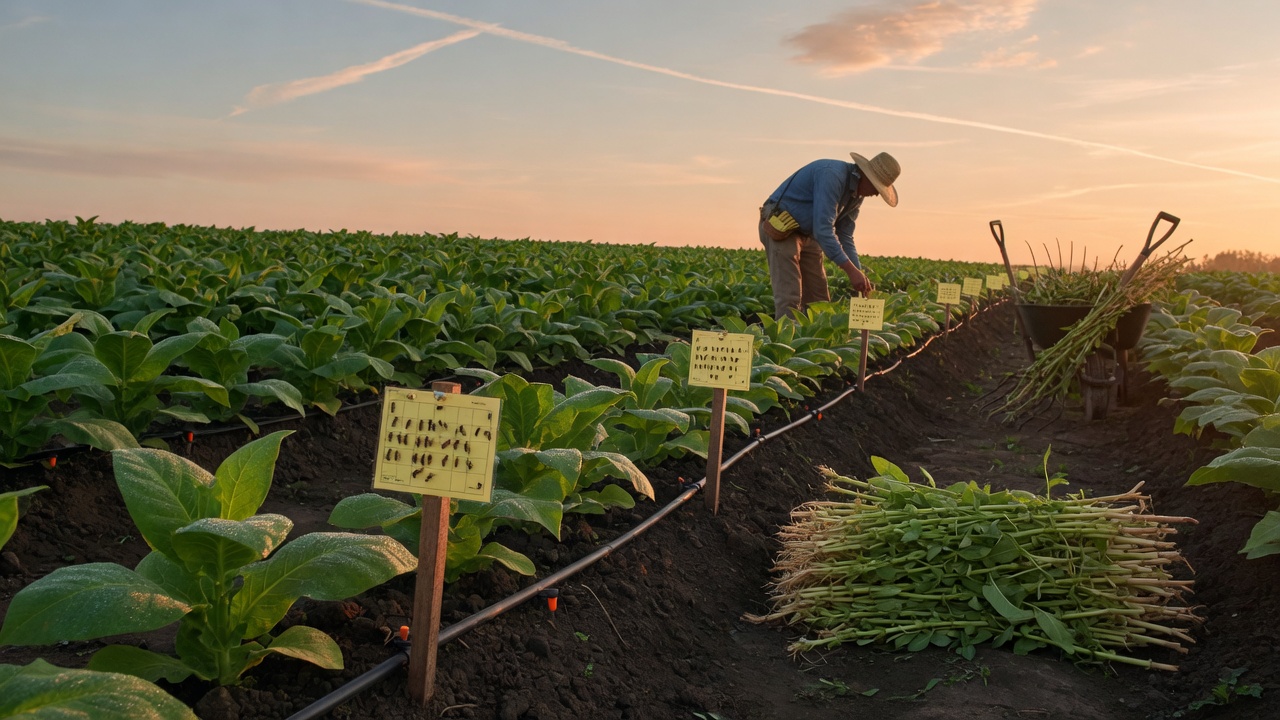
Precision agriculture and biological control applications in tobacco fields
Possible Pathways for Reducing Environmental Impact from the Cultivation Side — Precision Agriculture, Biological Control, and Waste Tobacco Leaf Management
In mid-May 2021, beside a tobacco field in a township of Chenzhou, Hunan Province, a technician attached a bag of Aphidius gifuensis "mummy aphid cards" to a bracket between the ridges, telling the farmer: "Don't spray imidacloprid these few days — the wasps haven't settled yet." The neighboring plot had just been sprayed, the liquid still wet on the leaves. Both plots were contract-grown for the same company — one following the green pest management protocol, the other sticking to the old habit of "spray as soon as aphids appear." When I asked how much the per-mu cost differed, the technician did a rough calculation: During the wasp-release season, chemical insecticide sprays were reduced by 1–2 applications, saving a bit on pesticide costs, but field monitoring and card placement required more labor. What was truly saved was that, after two years, the aphid baseline across the entire demonstration area dropped — no more "blanket spraying" at the first sign of trouble.
After that visit, I established a framework for myself: when it comes to reducing environmental impact from cultivation, don't start with grand narratives; first ask three things — Can water, fertilizer, and pesticides shift from "applied by habit" to "applied by need and timing"? Can pests be suppressed with natural enemies first before considering chemical backup? Are discarded leaves and tobacco stalks still being burned, dumped in ditches, or channeled into composting and resource recovery? Precision agriculture, biological control, and waste tobacco leaf management correspond exactly to these three questions. What follows is written based on the fields I've walked, the technicians I've interviewed, and the magnitude of published trials and local reports I've cross-referenced. Let me state one boundary upfront: Reducing nitrogen, phosphorus, and pesticide runoff from fields, and burning fewer tobacco stalks, improves the water and soil of the production area. The health impact of lighting and inhaling a cigarette will not be automatically canceled out because the production side went green.
I. My Overall Assessment: Three Legs, Different Priorities
Many people jump straight to promoting IoT-integrated water-fertilizer machines or "high-value extraction centers for waste." Equipment vendors like the former; capital stories like the latter. Standing within the real constraints of tobacco farmers and county-level technology extension, I find this order more realistic:
- **First, establish biological control and green pest management windows** — immediately reducing some insecticide exposure, directly benefiting natural enemies and nearby water bodies.
- **Then, shift fertilization and irrigation from "one-shot application" to "soil testing + split application + critical-period supplemental watering"** — nitrogen and phosphorus loss and groundwater loading mostly come from excessive base fertilizer and flood irrigation before rain.
- **Simultaneously build a closed loop for discarded leaves and stalks — off-field collection, composting, and fertilizer exchange** — more practical for most production areas than empty talk of solanesol extraction.
- **Leave high-value extraction and biochar production lines** for nodes that have redrying plants, concentrated industrial tobacco dust, and the necessary environmental and safety permits. Don't expect every village to build a refining workshop.
- **Recognize pest thresholds**: Tobacco aphids, tobacco budworms, and Spodoptera litura each have their peak periods; spraying at the first sight of any pest kills natural enemies and drives resistance.
- **Choose the right equipment and timing**: Early morning when dew is still present, or evening — droplet drift is minimal. Electric sprayers save pesticide and provide more uniform leaf coverage compared to "large nozzle brute-force spraying."
- **Coordinate with biological control schedules**: Set a **pesticide-free window** before and after wasp release (especially for imidacloprid-type insecticides that are highly toxic to wasps). This determines success more than buying a crop protection drone.
- **When contracts push for yield and superior-grade leaf ratios**, farmers and technicians tend to add more nitrogen and more spray cycles — the precision plan gets undermined by "insurance-based over-application."
- **If soil test results come back the following year**, they are worthless. They must be delivered two weeks before pre-planting preparation so the formula can still be adjusted.
- **The first-year investment in drip irrigation** (pipes, filters, pump) — without project subsidies, scattered farmers can't justify the cost, and the next year they dismantle the pipes and discard them as waste.
- **Extreme 1**: Promoting "released wasps = green, no pesticides" — when farmers have one failure, they reject the whole approach.
- **Extreme 2**: Treating wasps as a decoration, spraying weekly anyway, and writing it into green control summaries.
- **If the collection radius exceeds about a dozen kilometers**, transportation costs crush the model. Village-level collection is essential; county-level factories process.
- **Applying immature compost to the field** causes root burn, attracts pests, and generates odor complaints.
- **Poor management of nicotine and salt content** — fertilizer exchanged out may cause disputes when used on sensitive crops, requiring process control and testing support.
- Requires stable raw material supply, hazardous chemical and environmental compliance, and market fluctuation tolerance.
- The extraction waste liquid and residue still need a disposal pathway; otherwise pollution just moves to a different workshop.
- Offers almost no direct cash benefit to scattered farmers — settlement must go through purchasing companies or cooperatives.
- Set up waste leaf and stalk delivery points during thepurchasing season, priced or exchanged for fertilizerpoints;
- Sign contracts with qualified organic fertilizer plants or station-run composting facilities, with maturationtargets written into the contract;
- Use the compost the next season on tobacco or surrounding fruit and vegetable crops, forming "waste out, fertilizer in";
- Redrying plant dust goes separately to industrial extraction or centralized fertilizer production, with field logistics accounted for separately.
- **Spell out green pest control and waste leaf delivery obligations in contracts**, paired with technical tolerance that does not harm grade evaluation (e.g., explanatory space for identity fluctuations during early nitrogen reduction).
- **Priority use of unified prevention funds for buying wasps, monitoring, and organic fertilizer redemption**, rather than for buying more of the same chemicals.
- **Crop rotation and winter green manure** (see sustainablecultivation practices in various production areas) should run in parallel with the three pathways in this article: on land with severe continuous-cropping disease, wasps and precision fertilization both achieve less.
- **Inter-plot coordination**: one household releases wasps while three neighboring households spray — biological control will statistically fail.
- **Cultivation-side loss reduction must be done, but concept-swapping is prohibited.** Less pesticide, less nitrogen loss, less burning — these areproduction area responsibilities; not marketing rhetoric of "this tobacco is healthier."
- **Biological control should be the first move in tobacco area pesticide reduction.** The Aphidius gifuensis technology is more mature than most trendy hardware. First get the pesticide-free window and release timing strict.
- **Precision agriculture should first proceduralize manual operations, then talk about automation.** Soil testing with tiering, split fertilization, critical-period water conservation — one year can produce comparable nitrogen and irrigation data in demonstration villages.
- **Waste tobacco leaves should prioritize composting for fertilizer exchangeclosed loop; high-value extraction stays at the industrial node.** The village-level goal is "no burning, no dumping, can return to the field"; at the city level and above, then talk about the solanesol story.
- **Evaluation indicators must change.** Don't just report the superior-grade leaf ratio. Track in parallel: **per-mu active chemical pesticide ingredientusage, pure nitrogenusage, waste leaf recovery rate, wasp release coverage rate.** Without assessment, the pathway is just a PR piece.
- **The farmer's ledger must add up.** Any labor-increasing technology that does not offer fertilizer exchange, pesticide cost savings, or project subsidies will be abandoned after two years — this is not a "farmer quality issue," it is a rational choice.
- **Winter fallow (November–February):** Initiate waste leaf and stalk collection for fertilizer exchange; soil sampling and formulation; winter green manure or rapeseed cover (linking with sustainable cultivation measures).
- **Nursery–transplanting (March–April):** Reserve wasp sources; implement base fertilizer reduction by soil fertility tier; lay drip/hose irrigation in demonstration plots.
- **Mid-field early stage (May–June):** Release wasps at the first spot of aphids; enforce the pesticide-free calendar; follow the water and fertilizer plan before vigorous growth.
- **Maturity and curing (July–September):** Collect unusable fresh leaves and bottom leaves atrecovery points; ban field burning; record pesticide reduction counts and collection tonnage per village.
- **End-of-season review:** Compare demonstration and control villages on nitrogen and pesticide inputs, mummy and aphid damage levels, burning complaints; decide whether to expand the area the next year — not whether to buy the next set of sensors.
The three pathways are not mutually exclusive; they stack. If you cut fertilizer without releasing wasps, aphids will return and force pesticide use again. If you only release wasps without improving fertilization, soil acidification and non-point source pollution persist. If you don't treat waste, a single burn in the field turns "green production" into smoke and dust on the ledger.
II. Precision Agriculture: What Actually Works in Tobacco Fields, Not Concept Machines
### 1. What "Precision" Looks Like in Tobacco Fields
In published materials, the common magnitude for water-fertilizer integration in protected vegetables is: fertilizer use efficiency can increase by about 15%–30%, and water savings can exceed about 30%–35%. Flue-cured tobacco is not a greenhouse cucumber, but the logic is transferable — what is reduced is ineffective water,ineffective nitrogen, and reckless spraying before rain. The zero-growth action for chemical fertilizer and pesticide use promoted by agricultural and rural departments is driven by excessive fertilization causing rising costs, soil compaction, and non-point source pollution — tobacco fields are no exception.
In Yuxi, Yunnan, and Qiannan, Guizhou, the "semi-precision" practices I observed were typically not drone-based variable-rate fertilization everywhere, but a more grounded, replicable four-part set:
| Step | Practice | Typical Magnitude/Key Points | Common Pitfall |
|---|---|---|---|
| Soil testing and formulation | Take 0–20 cm composite sample before transplanting; issue formula based on alkali-hydrolyzable N, available P, available K, and pH | Divide the same village into 2–3 fertilization tiers by soil fertility | Sampling too late when fertilizer already purchased; or sample not representative |
| Base fertilizer reduction | Cut nitrogen from the habitual amount first on high-fertility plots, maintain potassium grade | Demonstration sites commonly show "about 15%–30% nitrogen reduction from habit" steps | Farmers fear "inadequate grade" and secretly add urea at night |
| Split top-dressing | Apply based on growth vigor after transplant recovery, rosette–vigorous growth, and topping stages | Water-soluble fertilizer or dissolved fertilizer applied in holes, fewer times with more volume per application | Consecutive rainy days prevent field entry, disrupting the plan |
| Critical-period irrigation | Drip/hose irrigation during root extension–vigorous growth water-sensitive period, avoid flood irrigation | Particularly critical for dryland tobacco; drip irrigation significantly reduces percolation and evaporation losses | First-year pipe clogging, rat damage to pipes, electricity cost and water source disputes |
Around 2019, I visited a water-fertilizer integration demonstration of about 80 mu in a county in Guizhou: main pipe plus drip tape laid along the ridges, with fertilizer solution injected in three splits according to the plan. The technician's original words were quite honest: "It's not about making every plant 'digital'; it's about preventing the rainy season from washing half a bag of compound fertilizer into the ditch." The neighboring control field still used the "one-shot" furrow application before transplanting. After two heavy rains in June that year, foam and algae were clearly visible in the control field's furrows, while the demonstration field's ditch water was clearer — this is not laboratory spectroscopy, but a visible difference.
### 2. "Precision" on the Application Side: Timing Matters More Than Machines
The priority order for precision pesticide application in tobacco fields is:
In the zero-growth pesticide promotion materials, the recurring terms are unified prevention and treatment, and reduction with increased efficiency — at the tobacco station level, this means: villages that can unify prevention should not let each household spray chaotically; what can be suppressed biologically should not lead with chemicals.
### 3. Personal View: The Real Enemy of Precision Agriculture in Tobacco Areas Is "Delivery Anxiety"
Technically, soil testing, split application, drip irrigation, and timed spraying are all mature. The bottlenecks are almost entirely institutional and psychological:
So I argue: county-level extension should not first invest in the most expensive sensor arrays. First achieve "one village, two fertilization tiers + critical-period hose/drip irrigation + pesticide-free calendar for wasp release." With these three in place, non-point source pollution and pesticide residue pressure will drop first; IoT can be the icing on the cake in a second phase.
III. Biological Control: Aphidius gifuensis Is the Foundation, Not a Myth
### 1. Why Tobacco Fields Are Suited to Tackle Aphids First
Tobacco aphids are almost a "standard pest" in every tobacco region. Once chemical dependence forms, natural enemies (ladybugs, hoverflies, aphid parasitoids) collapse. Aphidius gifuensis, which parasitizes tobacco aphids to form mummies, can already be mass-reared and commercialized in China. Yunnan and other regions have conducted demonstration projects for nearly twenty years, with numerous reports of increased natural enemy species and populations in demonstration areas. Hunan, Sichuan, Fujian, and other provinces also have cases of "using wasps to control aphids" entering villages and even serving larger agricultural crops like peppers and citrus.
On the cost side, published references give this order of magnitude: Applying Aphidius gifuensis to control tobacco aphids can reduce per-mu control costs by about twenty yuan (varying due to reduced spraying and labor structure). In surveys of service to larger agriculture in Liancheng, Fujian, parasitism rates on crops like peppers and citrus before wasp release were around 9%–10%, increasing to about 50%–66% after release — these are orchard survey figures, not guaranteed values for every tobacco field, but they show that once wasps establish, parasitism rates can multiply.
### 2. A Field Protocol I Would Write in My Notebook
Synthesized from technician interviews and published technical plans from Hunan and Yunnan (2018–2022), the field rhythm is roughly:
| Period | Action | Key Points | Pitfall Record |
|---|---|---|---|
| Nursery stage–pre-transplant | Rear wasps or order wasp cards/mummies | Host plant and wasp-aphid ratio follow local plan; Yunyan-type hosts often produce higher wasp quantities | Distant rearing facility or logistics delay → miss early aphid emergence |
| Aphid spot occurrence | First wasp release | Release as soon as aphids are seen; don't wait for full-field "greasiness" | Waiting for infestation before release = chemical firefighting |
| 7–10 days before/after release | Ban broad-spectrum insecticides | Especially neonicotinoids highly toxic to wasps | Drift from neighboring plot spraying kills demonstration colony |
| Around aphid peak | Supplementary release based on parasitism rate | Check mummies in the field, assess "bran-like" parasitism status | Releasing only once and ignoring follow-up — effectiveness drops sharply |
| Throughout the season | Yellow sticky traps, sex pheromone lures, manual removal of tobacco budworms | Biological control is a system, not a single tactic | Only releasing wasps while ignoring leaf-feeding pests — farmers lose trust |
In April 2020, grassroots reports from Hengyang and other locations emphasized three things: flue-cured tobacco production coverage, farmer training, and technology-driven approaches. My on-site feeling is: In the first year, administrative push and technicians are needed to enforce releases. By the second year, aphids decrease. By the third year, farmers start proactively asking, "When do the wasp cards arrive?" Trust is built by the season, not by press release.
### 3. What Green Prevention and Control Practices in Jiangyong, Yunnan, and Elsewhere Have Taught Me
In Jiangyong, Hunan, and similar production areas, "using insects to control insects" has been written into the standard vocabulary for tobacco fields. The essence is building an environmentally friendly pest control barrier: wasps suppress aphids, and chemicals retreat to a backup role. Yunnan materials also note that after long-term persistence, populations of ladybugs and Encarsia formosa can also rise — natural enemies are a community; the parasitoid wasp leads the way. The green production practices for Danjiangkou cigar tobacco, for instance, bundle soil conservation, green pest control, and fertilizer and pesticide reduction together — showing that biological control alone is not enough; it must be part of a "greenification system."
### 4. Personal View: Biological Control Reduces "Default Spraying," Not "Never Spraying"
In outbreak years, migratory aphid peaks, or after continuous heavy rain when wasp activity is poor, low-toxicity targeted chemical supplements may still be necessary. I oppose two extremes:
The feasible direction is: Wasps + monitoring + threshold-based supplementary control + inter-plot coordination. If a county can push wasp coverage from tobacco fields into the broader agricultural landscape — fewer pesticide sprays on fruits and vegetables, softer pest pressure on the periphery of tobacco areas — this is the direction that appears repeatedly in public extension materials and is most worthy of fiscal investment.
IV. Waste Tobacco Leaf Management: First Close the Loop, Then Talk About "Squeezing Every Drop"
### 1. Where the Waste Comes From
In the field: bottom leaves, diseased/damaged leaves, unusable fresh leaves, topped and suckered material, tobacco stalks.
In the station and industry: off-grade leaves, redrying dust, cigarette-making and packaging dust and trimmings.
The common fate in the past was field burning, ditch burial, or mixing with household waste. Burning contributes to local air pollution and neighborhood conflicts; burial creates organic loading and potential nicotine leaching problems. If the industry wants to talk about reducing environmental impact, the waste ledger is as important as the fertilizer and pesticide ledger.
### 2. Three Technical Pathways, Different Real-World Priorities
(1) Composting / Organic Fertilizer — The Main Channel for Most Production Areas
Tobacco waste composting is cited in literature reviews as one effective way to achieve scaled utilization: control the carbon-to-nitrogen ratio, moisture, aeration, and temperature; after maturation, use as base fertilizer or raw material for commercial organic fertilizer. Some trials use tobacco dust mixed with mushroom residue to produce fertilizer, then apply it to citrus and other crops, following a "reduce both pesticide and fertilizer" narrative. A moredown-to-earth local practice is "register delivery this year, exchange for organic fertilizer next year" — for example, in Shizong, Yunnan, reports describe a model where leftover tobacco leaves are sent to an organic fertilizer plant for fermentation and composting, exchanged by quantity. This solves three problems: the field has a disposal outlet, farmers feel a tangible benefit, and organic material can partially replace chemical fertilizer.
Pitfalls I have witnessed:
(2) Active Ingredient Extraction — High Barrier, Fluctuating Profits, Suitable for Industrial Nodes
Waste tobacco leaves can yield nicotine, solanesol, proteins, etc. Published industry reports describe companies pursuing a cascade utilization path of "solanesol — pharmaceutical intermediates — nicotine for biological pesticides," aiming to "squeeze every drop." The direction is correct, but:
(3) Biochar, Fiber, Feed, etc. — Deploy Where R&D and Conditions Are Mature
Biochar organic fertilizer, paper fiberboard, etc., are areas of scaled research; cost and energy consumption determine their suitability forcentralized raw material points. The feed pathway still needs to pass safety and palatability tests; it cannot be undertaken with village-levelmakeshift methods.
### 3. Personal View: When the Industry Narrative Turns from "Harmless Treatment" to "Resource Utilization" Around 2025, Don't Skip Steps
Investment materials like to write about 2025–2030 high-value utilization, declining extraction costs, etc. I take a colder stance from the production area standpoint: Without off-field collection and basic composting for fertilizer exchange, the high-value story is a castle in the air. The minimum viableclosed loop at the county level is:
Research articles on comprehensive utilization of field tobacco waste have long pointed out that this concerns both farmer interests and sustainability — I add: Without cash or fertilizer-exchange incentives, education and advocacy cannot break the burning habit.
V. How the Three Pathways Stack: An Executable Combination Table
| Priority | Pathway Combination | Main Environmental Benefit | Who Pays / Who Organizes | Verifiable Signal Within One Year |
|---|---|---|---|---|
| P0 | Aphidius gifuensis coverage + pesticide-free window + yellow sticky traps + sex pheromone lures | Reduced insecticide frequency, natural enemy recovery, lower pesticide residue pressure at field edges | Tobacco station unified prevention funds + minor farmer labor input | Number of chemical aphid control sprays in wasp-release fields; visible mummies |
| P0 | Waste leaf/stalk delivery for fertilizer exchange | Less burning, organic material returned to field, partial replacement of chemical fertilizer | County company + fertilizer plant + points system | Collection tonnage; number of burning complaints |
| P1 | Soil testing with tiered fertilization + base nitrogen reduction starting at 15% | Reduced nitrogen and phosphorus loss risk, eased acidification pressure | Soil and fertilizer project + contract technical package | Per-mu pure nitrogen; ditch water sensory and simple monitoring |
| P1 | Drip/hose irrigation during critical water-need periods, replacing flood irrigation | Water savings, reduced nutrient leaching with water | High-standard farmland / project subsidies | Irrigation frequency and electricity cost; transplant recovery in dry years |
| P2 | Sensors, drone-based variable-rate application, village-level data platform | Management precision raised another level | Pilot projects | Only proceed after P0/P1 are stable |
| P2 | Industrial extraction of nicotine/solanesol from tobacco dust | High value, reduced industrial solid waste | Industrial enterprises | Compliant production line and residue disposal pathway |
At a production area symposium in 2022, I heard a debate: some said without IoT, it wasn't precision agriculture. My response remains the same: The opposite of precision is waste, not non-intelligence. Reducing nitrogen from "habitual 10 kg" to "soil-fertility-tiered 7–8.5 kg," changing aphid control from "weekly spraying" to "wasp suppression + threshold-based supplementation," switching tobacco stalks from "a match" to "a load of fertilizer" — these already capture the bulk of loss reduction on the cultivation side.
VI. Policy and Contracts: Whether the Technology Stays in the Field Depends on Extrinsic Constraints
The ecological environment and agricultural/rural departments have long had governance requirements for agricultural non-point source pollution, pesticide packaging, and straw-type waste resource utilization. The tobacco company system faces multiple assessments: green pest control, chemical fertilizer reduction, leaf quality, and industrial demand. When these three conflict, delivery structure often overrides environmental indicators.
Feasible institutional patches include:
The common structure of cases like greenification of Danjiangkou cigar tobacco, expansion of Aphidius gifuensis into broader agriculture, and waste leaf fertilizer exchange is: technology package + organizational package + a real injection of funding. Remove any one corner, and the pathway retreats to a PowerPoint slide.
VII. Specific Opinions I Hold Firmly (No Fence-Sitting)
VIII. Closing: A One-Year Roadmap I Would Recommend to a County-Level Technical Manager
If given only one county, one curing season, plus one winter fallow window, I would schedule as follows:
Reducing environmental impact from the cultivation side — no single pathway can save a watershed alone — but getting the four words — wasps, fertilizer, water, waste — right on the ground can already pull tobacco fields down a notch from being "dual contributors to non-point source pollution and smoke." The fields I've walked tell me: shouting about transformation is easy; the real paths are watching that pesticide-free week, hauling away that load of waste leaves, and taking those extra kilograms of nitrogen out of the bag. The paths don't need to be reinvented. They need to be given space in contracts and assessments that isn't erased by "insurance-based over-application."