Traditional "Pilón" (Stack Fermentation) vs. Modern Controlled Fermentation
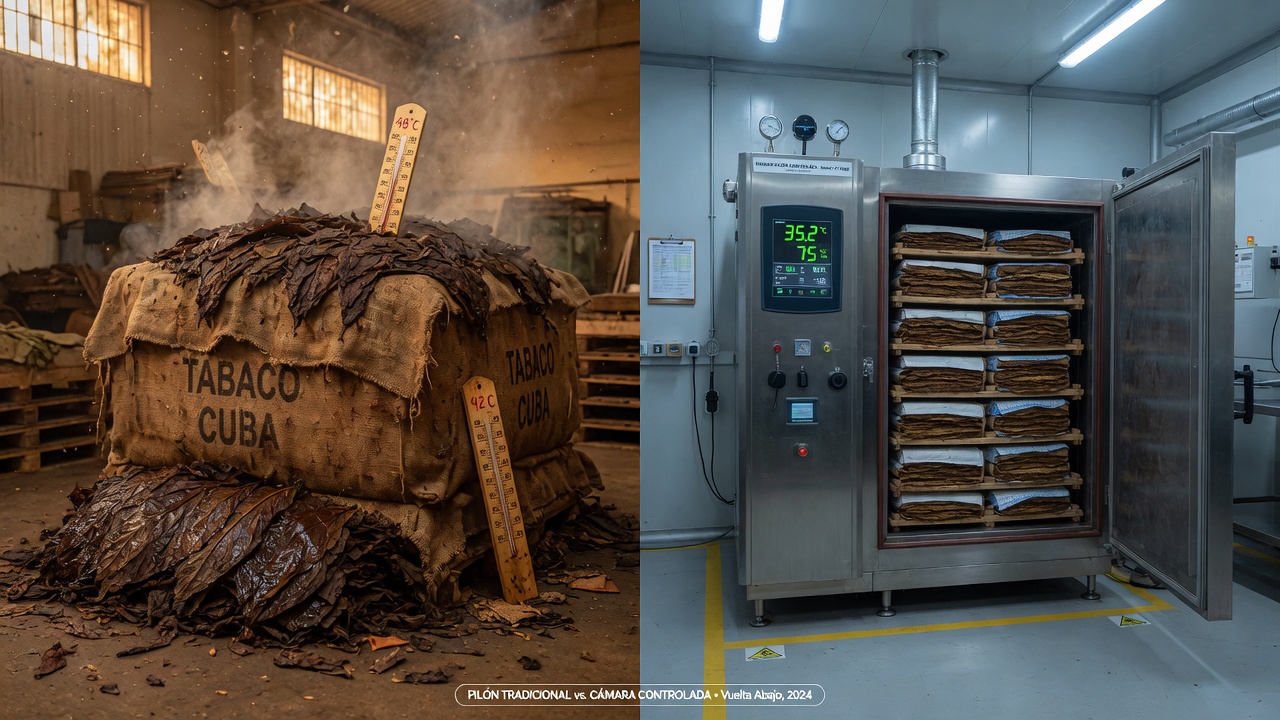
In September 2021, at a Yunnan cigar raw material pilot workshop, two stacks of the same batch of middle leaves were placed side by side. On the left was a traditional pilón: about 1.5 m wide, 1.2 m high, wrapped in burlap, with thermometers inserted at the top, middle, and bottom, relying on the leaf pile's self-generated heat to rise. On the right was an experimental stack in a controlled room: room temperature locked at 35°C, relative humidity held around 75%, target moisture content for reconditioning about 30%, with a curve tracked by the clock.
When opened, the difference did not require imagination. The left stack's core once reached 46°C, ammonia rushed out first, followed by wet wood and a hint of overripe fruity sweet-sourness; the leaf surface was darker and oilier, with visible differences between inner and outer leaves in the same handful. The right stack was more "uniform" — the ammonia was less explosive, green off-notes were cleanly suppressed, but on the first test draw, the cocoa and woody notes had shallower rise and fall. The same variety, same stalk position, same curing batch, differing only in who provides the heat, where the temperature stops, whether and how you turn the pile — and the flavor budget was split into two different systems.
This article is not about which is more "orthodox." Pilón and controlled fermentation compete over control and reproducibility cost, not civilizational hierarchy.
I. Aligning Terminology: What Fermentation Changes
Curing (air-curing, etc.) removes most free water and roughly fixes color; fermentation comes after curing with very practical goals:
- Suppress green and harsh notes;
- Let nitrogenous irritants (commonly the ammonia sensation that emerges first during the process) complete their intended pathways;
- Drive enzymatic hydrolysis, microbial metabolism, and non-enzymatic reactions of sugars, proteins, pigments, and aroma precursors;
- Improve toughness, burn quality, and batch usability, leaving adjustable material for blending.
In leaves that skip adequate fermentation, common findings during test smoking include: nasal irritation, ammonia smell like an unclosed cleaning agent, short and scattered aroma, and dark loose ash. Fermentation solves "whether it's usable and which direction the style leans," not rewriting tobacco's health attributes. All process discussions below stay within flavor and industrial logic.
The biochemical underpinning of both paths is actually the same system: water acts as the medium, microorganisms and endogenous enzymes do the work, metabolic heat generation in turn screens the microbial community and reaction rates. The differences are:
| Dimension | Traditional Pilón (Stack Fermentation) | Modern Controlled Fermentation |
| Main heat source | Pile self-heating + passive environmental influence | Room/chamber heating or precise temperature control + possible internal self-heating |
| Control method | Insert thermometer to read core temperature, turn pile at target temp, experience-based water addition | Set temperature and humidity curves, standardized pile geometry, sensors and SOP |
| Strengths | Scale, stylistic "character," inheritable experience | Uniformity, testability, scalable reproducibility |
| Weaknesses | Batch variation, labor and space costs, burn/spoilage risk | Copying wrong parameters can "iron out" flavor; equipment and energy costs |
In published industry accounts, Nicaragua and other regions sort air-cured leaves (approximately 45–65 days), bundle them into about 35-leaf gavillas, and stack them into compost-like pilóns; initial fermentation commonly targets a core temperature of approximately 110–115°F (about 43–46°C), at which point the pile is dismantled, shaken, and restacked. Domestic factory descriptions commonly cite: wrapper reconditioned to approximately 20–30% moisture, filler approximately 25–35%, moisture equilibration 12–24 hours, pile width approximately 1.5±0.1 m, height approximately 1.2±0.1 m, wrapped in burlap, thermometers at top/middle/bottom, turning triggered by layer temperature limits. Numbers shift by region, stalk position, and variety, but the structure remains the same: pile geometry + moisture + core temperature + turning rhythm.
II. Traditional Pilón: Self-Heating Is the Engine, Turning Is the Brake
1. How It Works on Site
A common processing chain can be compressed into steps (names and counts vary by region, but the logic is consistent):
2. Its Real Advantages
First, the thermal gradient itself is a style generator.
The core, middle layer, and outer layer differ in temperature and oxygen partial pressure, so microbial and chemical reactions do not proceed in lockstep. Turning is "deliberate mixing," but before mixing, the pile has already gone through a phase of uneven progression. Many experienced craftsmen favor the rough edges this path leaves behind: deeper woodiness, a hint of fermentation acidity, sweetness that rises only in the later stages. In 2020 I spent three consecutive days at a small workshop in the Dominican Republic watching the same batch of Viso: before the first turn the ammonia was most intense, after the second turn the pungency subsided, after the third turn the leaf surface became oilier, and the pepper sensation in the test roll transformed from harsh into an acceptable structure. This "segmented personality" on the timeline cannot be captured by average values in a table.
Second, scale and cost structure suit the harvest season.
When the harvest peak arrives, tons of leaves enter the factory. Pilón may look unsightly in terms of floor space, but its unit processing capacity is high and does not require every cubic meter to be filled with heating pipes. It struggles when labor and space are expensive; in regions where labor and warehouse space are still manageable, it remains the mainstream backbone.
Third, experience can be compressed into "hand-feel rules."
For example: turn upper leaves more frequently, keep the wrapper temperature ceiling lower, reduce spraying during the rainy season, consider dismantling when core temperature stops rising for two consecutive days. The rules are not elegant, but they can train newcomers.
3. Its Real Costs
Batch variance is the default configuration.
For the same blend name, if the warehouse ambient temperature differs by 3–4°C between September last year and September this year, or the spray gun flow rate differs slightly, the curve will drift. Blenders later use aging time and blending ratios to erase this difference.
Burnout and mold are two sides of the same coin.
High moisture, large pile, late turning → core temperature runs out of control, leaves turn dark and brittle, aroma collapses into scorched bitterness; uneven moisture, poor ventilation, wet outside dry inside → corner mold, local anaerobic spoilage. In July 2023 during hot humid weather, I saw a pile whose bottom layer lacked a moisture barrier: when opened, the lower 15–20 cm had obvious musty odor, and the entire pile had to be picked through for waste. Tradition is not "naturally safe" — it depends on how diligently people monitor it.
Labor intensity and responsibility pressure are bound together.
At 2 AM, when the core temperature hits its upper limit, you have to call people to dismantle it. A controlled room can shift some of the pressure to alarms; pilón leaves the pressure to the night shift worker.
My view:
Romanticizing pilón as "ancestral wisdom not to be violated" and dismissing it as "dirty and messy" are both lazy. It is a high-throughput, experience-dependent bioreactor operation method. Done well, the flavor has edges; done poorly, the losses come in entire piles.
III. Modern Controlled Fermentation: Turning Environmental Variables into Knobs
1. What Exactly Is "Controlled"
The modern path is not a single machine, but a set of capabilities:
- **Closed fermentation room / constant temperature and humidity chamber**: Room temperature and relative humidity are adjustable (common test and process windows show ranges like **35–45°C**, relative humidity **70–85%**; specifics depend on leaf type).
- **Standardized pile geometry and reconditioning**: Uniform length, width, height, and equilibration time, reducing temperature variation from "same process, different geometry."
- **Layered temperature measurement, alarm-triggered turning**: Converting "hand feel" into "any layer reaching its limit triggers turning." Domestic factory descriptions have wrapper and filler in separate rooms with different layer limits (wrapper approximately **36–40°C** range, filler up to **41–43°C** level), essentially acknowledging that different stalk positions have different heat tolerance.
- **Experimental design**: Fix moisture at approximately **30%**, humidity at approximately **75%**, make temperature the single variable (e.g., **30 / 35 / 40 / 45 / 50°C**), run fixed days, and use chemical indicators and sensory scores to back-derive the curve — this is an increasingly common language in research and industrial pilot work.
One point must be stated clearly: room temperature ≠ core temperature.
Setting the chamber at 34°C, a large pile can still reach over 40°C due to self-heating. Reporting only "fermentation room at 34°C" without reporting core temperature is self-deception. Traditional craftsmen watch the core; if modern methods only watch the room, they will repeat the same accidents, just in cleaner rooms.
2. The Directional Effect of the Temperature Knob on Flavor (Consensus Zone from Research and Field)
Overlaying published experiments and warehouse experience, the direction is roughly stable:
- **Relatively low temperature range (approximately 30–35°C level)**
More favorable for total aroma yield, accumulation of degradation products related to floral, fruity, woody, and "fresh" notes; sweetness, aftertaste, and fullness sensory scores tend to be better; bacterial biomass is commonly higher around 35°C, while fungi prefer slightly lower temperatures. Indicators related to burn quality, such as potassium-to-chlorine ratio, also tend to handle better at lower temperatures.
Cost: the "sharpening" of irritants and nitrogenous systems may not be fast enough, requiring a longer cycle or a subsequent medium-high temperature phase.
- **Medium-high temperature range (approximately 45–50°C level)**
Total nitrogen and alkaloids are more easily suppressed, the "hard edges" of irritation and off-notes are blunted; Maillard pathways are more active, with baking, nutty, and caramel molecules more likely to emerge.
Cost: total aroma may decline, floral-fruity-woody notes may be "baked soft"; microbial populations are significantly inhibited (in many observations, >45°C sharply reduces microbial counts), conversion relies more on heat and enzymes, and the style tends to become "uniform."
So the real power of controlled fermentation is not locking onto a single "golden temperature" forever, but daring to use variable temperature: lower temperature early to accumulate aroma and microbial activity, medium temperature in the middle to reduce irritants, stable at the end without further rise. Soy sauce, tea, and some cigar pilot work all use segmented approaches — the same applies to tobacco, but parameters must be recalibrated by variety. The optimal window for Sichuan Dexue No. 1 and a Hubei variety can differ by over ten degrees Celsius — such things are not unusual in the warehouse.
3. Advantages and Traps
Advantages are solid:
- Intra-batch uniformity rises, blend reproducibility costs fall;
- Newcomers following SOP can also reduce burn losses;
- Controlled experiments become possible: change 5°C, see how sugars, alkaloids, volatiles, and sensory scores respond;
- Space utilization, digital recording, and traceability are more friendly.
Traps are equally solid:
- **Mistaking "clean and stable" for "superior."** In 2024 I evaluated a batch of test filler run at a constant 40°C with almost no turning: the ammonia was reduced, irritation softened, but the mid-palate aroma felt sanded flat, lacking the "first surge, then settle, then oil emerges" temporal layering of traditional multi-round pilón. Stability is sometimes an advantage, sometimes the bill for flavor being ironed out.
- **Parameter transplantation failure.** Copying the core temperature limits of Cuban upper leaves onto Yunnan thin wrapper leaves has resulted in numerous cases of oil burn, carbonization, and aroma collapse. Controlled only guarantees you can repeat errors.
- **Equipment worship.** Sensors fail, calibration drifts, spray nozzles clog causing localized overwetting — accidents still happen, just with prettier reports.
My view:
The value of controlled fermentation is translating experience into testable hypotheses, not eliminating experience. The best controlled lines still need someone to smell the pile, touch the leaves, check the ash, and smoke control samples.
IV. On Final Flavor: Not Who Wins, But How the Budget Is Allocated
Using the same sensory ruler, place both paths on the test-smoking table:
1. Irritation and "Rawness"
- **Traditional pilón done properly, turned adequately**: the ammonia process note is unpleasant mid-process, but the endpoint is often usable; if turned late or poorly balanced, irritation can remain as sharp spikes.
- **Controlled medium-high temperature**: reduces irritation faster and more uniformly, beginner-friendly.
- **Controlled low temperature**: good aroma, but irritation management requires time or subsequent processing stages.
- **Traditional multi-round with temperature fluctuations**: more likely to produce "storytelling" wood, earth, fermentation sweetness, slight acidity, and layering from mixed stalk positions. The risk is dirtiness and instability.
- **Controlled low temperature**: floral, fruity, fresh sweetness, neophytadiene-related clean sensations are more easily preserved.
- **Controlled high temperature**: nutty, baked, caramel directions emerge; the "breadth" of complexity may give way to "cleanliness."
2. Aroma Profile
3. Burn and Physical Properties
Adequate fermentation (regardless of path) generally improves smoldering and ash whiteness; factory descriptions also use smoldering duration as one criterion for dismantling the pile. If traditional piles have localized overwetting or burnout, the burn will polarize — good leaves burn well, bad leaves drop dark ash.
4. Batch and Brand Language
Industrial products pursuing globally uniform flavors favor controlled methods and blending. For small-region, vintage, limited-narrative products, pilón's variance is sometimes written up as a selling point — provided the variance falls in "character" rather than "defect."
Personal judgment (stated clearly so you may disagree):
V. Two Personal Control Comparisons to Nail Down the Judgment
Control A: 2021 Yunnan pilot, same Viso, dual paths, 28 days.
- Pilón: core temperature peak approximately 45–46°C, turned 4 times, fine mist rehydration in second round followed by 14-hour equilibration. Endpoint leaf color deeper, aroma had wet wood and slight acidity, mid-palate pepper was clear in test smoking, aftertaste had slight fermentation sweetness. The same pile still had visible differences between edge and center, requiring selection during blending.
- Controlled room at 35°C / 75% RH / initial moisture about 30%: ammonia dropped earlier, sweetness score higher, irritation more uniform; but woodiness and "smoky sensation" were weaker by one grade, with two of three blind tasters saying "better smoke" and one saying "lacked memorability."
Conclusion: For a low-irritation commercial line I would lean toward controlled around 35°C; for blending with angular filler character, I would keep pilón or multi-round variable temperature.
Control B: 2023 Sichuan pilot, Dexue-type filler leaf, temperature single factor.
The 30°C group had more open aroma with better sweetness and aftertaste; the 45–50°C group had noticeably softer irritation with a baked character emerging, but total aroma declined. This aligns with the direction of "low temperature accumulates aroma, high temperature shaves irritation." Someone later changed the process to first 12 days at 33°C → last 10 days at 42°C, and the compromise between irritation and aroma sounded better than single-point constant temperature — this is a deliberate imitation of traditional "turning-induced temperature waves" using controlled means.
Mistakes encountered: once the room humidity was set above 85% with reduced turning frequency; after three days, condensate dripped from chamber corners onto the leaf surface, causing localized water stain spots and sourness, sharply increasing the risk of entire-batch spoilage. Controlled is not maintenance-free; it turns errors from "invisible" into "written on the curve."
VI. How to Choose: An Actionable Statement for Blenders and Raw Material Handlers
- You want **vintage character, small batch, willing to trade labor for personality** → traditional pilón (or a stacking system closely resembling it) is still the workhorse, monitor core temperature, be generous with turning, ensure equilibration.
- You want **cross-factory reproducibility, low training cost, e-commerce-grade consistent mouthfeel** → controlled room + standardized pile geometry + variable temperature curve, don't blindly trust single-point constant temperature.
- You want **both** → use controlled means to find the variety's window, use pilón or large-stack throughput for scaling; the key indicators are always **core temperature, moisture uniformity, and timeliness of turning**, not marketing buzzwords like "ancient method" or "smart."
Finally, nail down the position once more: Traditional stack fermentation sells the time and non-uniformity on the self-heating path; modern controlled fermentation sells turning temperature and humidity into an editable script. Flavor stands on the side of whether the script is written honestly — honesty means: you know clearly whether you are accumulating aroma or shaving irritants, you know the difference between room temperature and core temperature, and you know what skipping one turn will cost.
Tobacco leaves are not more virtuous for entering a stainless steel room, nor more soulful for being covered in burlap. Only the batch that completes its curve, suppresses its defects, and retains its target aroma deserves a place in the blend table.